Meal planning
Pork butt, picnic or whole shoulder? Read the raw package
On this page · 4 sections
Straight answer
Read the cut name, bone status, skin/trim description and actual net weight as separate inputs. A whole shoulder includes the butt and picnic; a package labeled shoulder need not contain that whole family. Boneless does not, by itself, settle every picnic skin option. [1] [2]
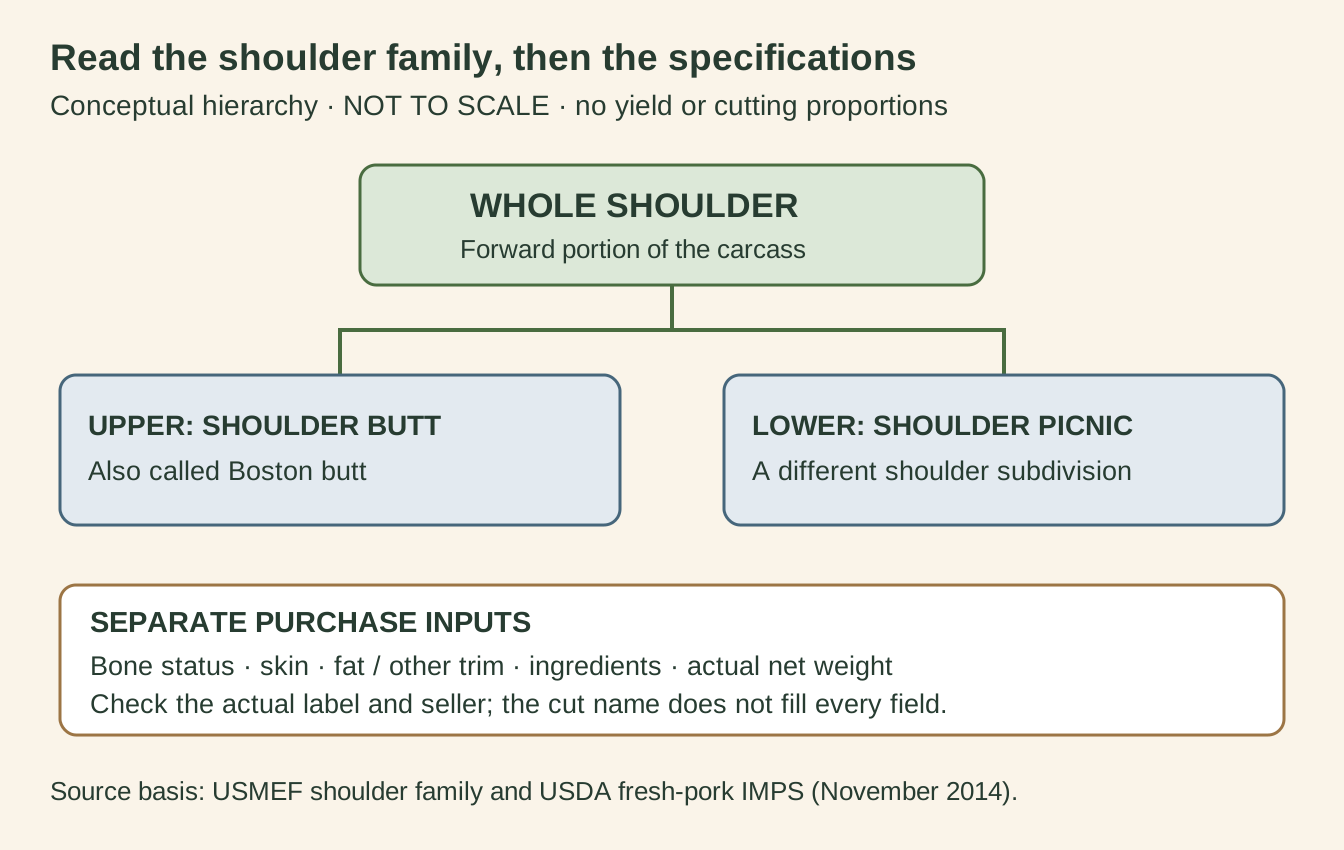
Start with the shoulder family
We matched four producer-hosted package-front images to their own current product pages on October 18, 2026, then used the US Meat Export Federation’s cut descriptions and USDA’s published November 2014 fresh-pork specifications to interpret the names. The original matrix distinguishes front-label evidence from page descriptions and unanswered details. We bought, opened and weighed none of these packages; the cost examples below use invented raw weights, not measured trimming or cooking yields.
On a narrow screen, scroll the table sideways to compare all columns.
| Family level | What it identifies | Separate checks |
|---|---|---|
| Whole shoulder | Forward shoulder; generally divided into butt and picnic. | Whole-cut identity still leaves skin, trim and weight questions. |
| Shoulder butt / Boston butt | Upper shoulder subdivision; USDA also identifies the Boston Butt name. | Bone-in, semi-boneless and boneless descriptions are different. |
| Shoulder picnic | Lower shoulder subdivision. | Bone and skin are separate specifications; do not infer both from one word. |
The USMEF explicitly allows purchaser choices for shoulder skin and surface-fat trim. USDA’s Item 405A boneless picnic removes skin in its base description but has a purchaser option leaving skin on. These procurement specifications explain why you should ask; they do not prove a retail package was ordered to a particular IMPS item or option. [1] [2]

Four producer examples, with missing details kept visible
The linked examples below are package illustrations supplied by producers, rather than photographs of four retail purchases. The front may say less than the page title. In particular, Swift’s page identifies its butt as boneless and its picnic as bone-in, while the pictured fronts use the broader cut names. Keep those two evidence levels separate. [3] [4] [7] [8]
On a narrow screen, scroll the table sideways to compare all columns.
| Example / cut identity | Bone evidence | Skin, trim and added-solution evidence | Weight basis / selling unit |
|---|---|---|---|
| Swift shoulder butt | Page: boneless. Front: shoulder butt without a bone-status word. [3] [7] | Page ingredients: pork. No quantified surface-fat trim is supplied; the inspected front does not state skin or added-solution detail. [3] [7] | Front says keep refrigerated. No actual net weight, price-per-pound label or sale-unit quantity is shown. [7] |
| Swift shoulder picnic | Page: bone-in. Front: shoulder picnic without a bone-status word. [4] [8] | Skin, exact trim and added-solution wording are not established by the inspected front/page. [4] [8] | Front says keep refrigerated. Net weight and whether the seller offers one piece, multiple pieces or a case remain unknown. [8] |
| Smithfield boneless picnic | Front and page identify boneless shoulder picnic. [5] [9] | The inspected sources do not settle skin, quantified trim or an ingredient/added-solution declaration. [5] [9] | Front says keep refrigerated. No retail net-weight sticker or actual selling unit is established. [9] |
| Smithfield bone-in butt roast | Front and page identify bone-in shoulder butt roast. [6] [10] | Skin, exact trim and added-solution wording are not established. A nutrition panel is not a substitute for an ingredient declaration. [6] [10] | Page title says fresh pork; the pictured front says keep frozen. Preserve that discrepancy and check the package being sold. Net weight / sale unit unknown. [6] [10] |
A seller can supply details missing from those fronts. Esposito Meats’ own picnic listing identifies bone-in, skin-on pork, an average 8–10 lb piece and $25 per roast. The captured page also says sold out. Here the selling unit is one roast, and the weight is an approximate range, not a net-weight sticker for an actual piece. Confirm the current package weight, offer and availability before using it as a purchase comparison. [11]
A single wrapped cut pictured on a website is not proof of how your seller prices or packs the item. Ask for the current full label and seller’s sale unit before comparing a per-pound offer with a per-package or case price. If you need skin-on picnic or a particular fat cap, request that specification explicitly; the family diagram cannot supply it.
Read added-ingredient wording independently of cut identity. The USDA specification permits purchaser-specified added ingredients, so the broad fresh-pork category does not itself settle that question. Record the actual package declaration instead of estimating it from appearance or a sodium number. Swift’s butt page provides an ingredients entry; that does not establish the other three products’ ingredients. [2] [3]
Compare the raw weight you intend to retain
Use purchase cost divided by the raw mass you expect to keep after your chosen removals. If the removal mass is only an assumption, label the result an estimate. Do not subtract the same bone or skin twice, and do not call the remainder cooked edible yield. Your decision about what to keep changes this denominator.
On a narrow screen, scroll the table sideways to compare all columns.
| Calculation | Hypothetical A | Hypothetical B |
|---|---|---|
| Purchased raw mass and price | 10 lb × $2.00/lb = $20.00 | 8 lb × $2.80/lb = $22.40 |
| Assumed raw mass removed | 2 lb total bone/skin/trim chosen for removal | 0.5 lb total chosen for removal |
| Raw mass retained | 10 − 2 = 8 lb | 8 − 0.5 = 7.5 lb |
| Cost per retained raw pound | $20 ÷ 8 = $2.50/lb | $22.40 ÷ 7.5 = $2.9866… ≈ $2.99/lb |
| What remains unknown | Actual removals, cooking loss and final portions | Actual removals, cooking loss and final portions |
A starts with a lower purchase price and stays lower in these particular assumptions. Changing either removal assumption can change the comparison. Neither example establishes a normal bone percentage, a typical trim loss, a better-tasting cut or how many people a real roast will feed.
Blank raw shoulder purchase record
Fill one copy per actual offer. Leave missing facts blank and request the full label. Use raw mass consistently; keep hypothetical removals separate from later observations.
These entries are personal notes. They are not sent to a restaurant or submitted to this site.
Link or photograph the actual offer.
Whole shoulder, butt, picnic or unresolved.
Label, producer page or unanswered question.
Record an explicit answer.
Do not infer a standardized trim from a name.
Copy the actual current declaration.
Keep any page/package discrepancy visible.
Per pound, package or case are different.
Exclude packaging; keep lb and kg separate.
Record per-unit basis and total.
Identify the basis and categories once.
Unknown if an input is unknown.
Label estimates and rounding.
Resolve must-have specifications first.

For the cooked menu words pulled and chopped, use the serving-form comparison. This worksheet ends at raw purchase identity and retained raw mass; a cooking plan needs its own recipe and food-handling guidance.
Sources and method
- USMEF US Pork shoulder-family descriptionsSource checked · usa-pork.org
- USDA IMPS Fresh Pork Series400, effective November2014Source checked · www.ams.usda.gov
- Swift Boneless Pork Shoulder Butt product pageSource checked · swiftmeats.com
- Swift Bone-In Pork Shoulder Picnic product pageSource checked · swiftmeats.com
- Smithfield Boneless Shoulder Picnic Roast product pageSource checked · smithfield.sfdbrands.com
- Smithfield Fresh Pork Bone-In Shoulder Butt Roast pageSource checked · smithfield.sfdbrands.com
- Producer-hosted actual package-front image 1Source checked · swiftmeats.com
- Producer-hosted actual package-front image 2Source checked · swiftmeats.com
- Producer-hosted actual package-front image 3Source checked · assets-us-01.kc-usercontent.com
- Producer-hosted actual package-front image 4Source checked · assets-us-01.kc-usercontent.com
- Esposito Meats own picnic listing, skin and selling-unit exampleSource checked · www.espositosmeats.com


How this article is prepared
Researched and drafted with AI assistance from the cited sources. Examples and calculations retain their stated assumptions; illustrations do not establish restaurant visits or equipment tests.
About BBQ Explorer