Meal planning
Whole packer brisket vs flat: compare the package before the price
On this page · 5 sections
Straight answer
Choose the package by its stated components, trimming and billing basis before comparing raw price. A whole packer includes flat and point, while a separated flat is a different purchase; “half,” “trimmed” and “deckle-off” need their own definitions. No package weight supplies a guaranteed cooked yield. [1] [2] [6]
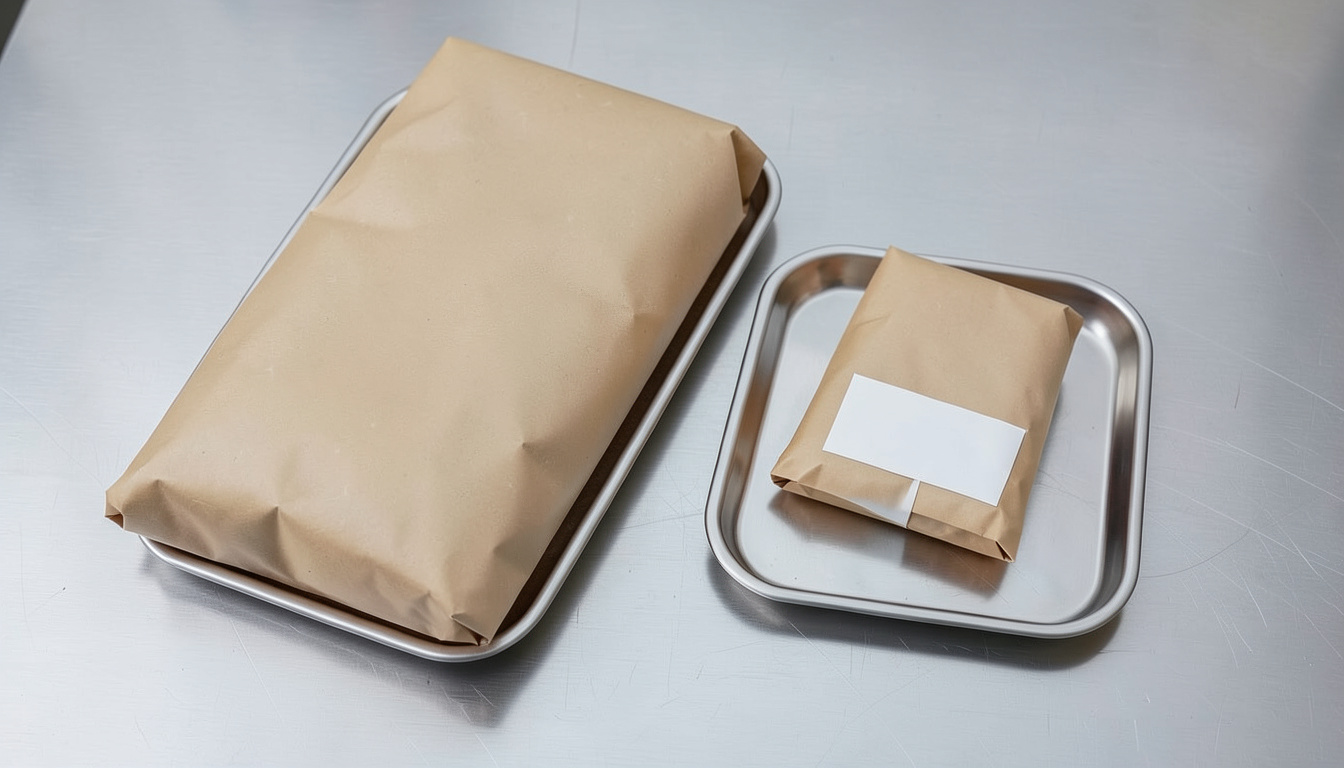
First identify what is in the package
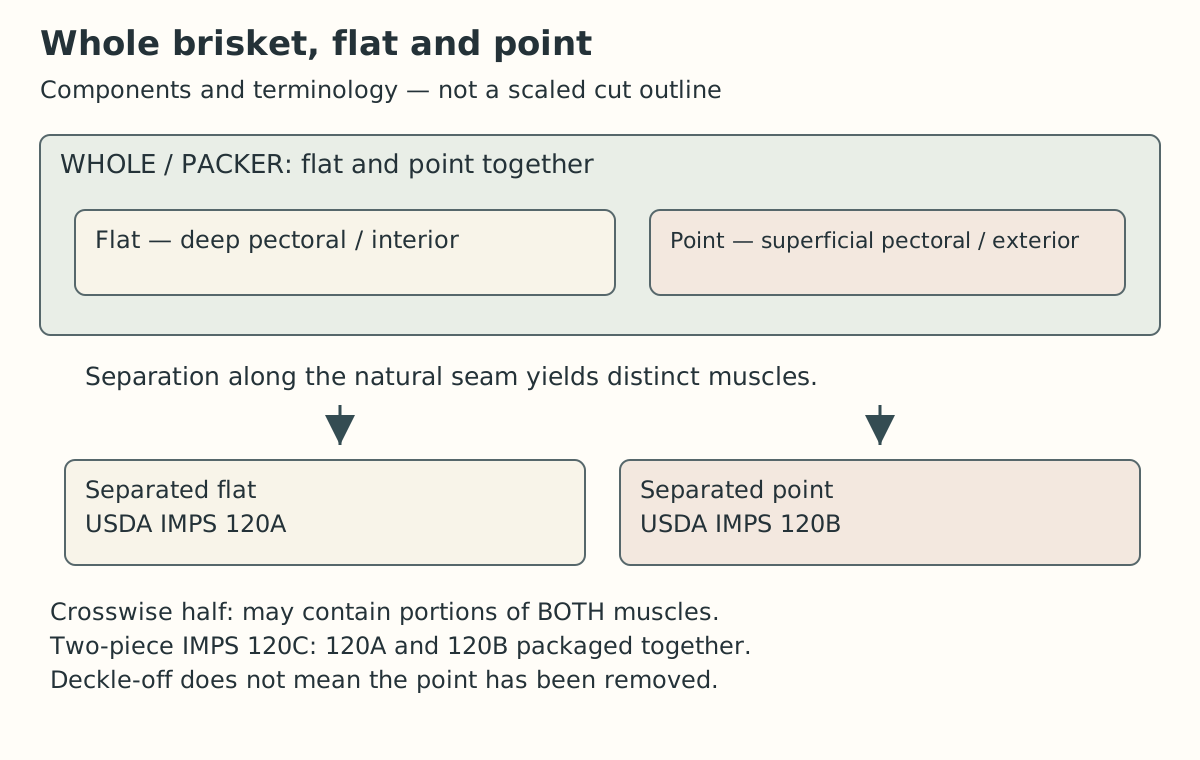
Texas A&M describes two principal brisket muscles: the deep pectoral, associated with the flat, and the superficial pectoral, associated with the point. They can be separated along their natural seam, or a brisket can be divided across its length so a “half” contains portions of both. [1]
On a narrow screen, scroll the table sideways to compare all columns.
| Package term | Documented distinction | Question to settle |
|---|---|---|
| Whole / packer | Flat and point remain together in the whole example; whole describes components, not a promise of no trimming. [1] [6] | Are the two muscles attached, or are separated pieces packed together? |
| Separated flat / point | TAMU describes separation at the natural seam; USDA identifies distinct flat 120A and point 120B items. [1] [2] | Is the offered flat the separated muscle or a crosswise portion? |
| Half brisket | A crosswise division can expose both major muscles; half is not automatically another name for a separated flat. [1] | How was this particular half divided? |
| Two-piece package | USDA 120C consists of 120A and 120B packaged together. That differs from assuming an attached whole. [2] | Does the seller use this institutional specification or a different retail definition? |
| Deckle-off | USDA’s deckle context concerns hard fat and intercostal material; do not use deckle as a precise synonym for the point. [2] | What has actually been removed, and what trimming remains? |
“Packer trim” commonly means minimal trimming in TAMU’s description, but a seller can also offer a whole brisket with its fat cap trimmed. Read whole/flat as the component question and trimmed/untrimmed as a separate question. [1] [6]
Four real offers show why units and trim matter
On a narrow screen, scroll the table sideways to compare all columns.
| Seller / stated cut | Trim claim | Weight shown | Price and basis observed | Unknown to settle |
|---|---|---|---|---|
| Creekstone Prime Whole Brisket (Competition) [3] | No numerical fat-cap depth in the selected description. | Small 12–14 lb; Medium 14–16 lb; Large 16–18 lb. [3] | $165 USD with Small selected; one whole competition brisket, not a displayed $165/lb quote. [3] | Actual piece weight, remaining trim, selected-option availability and delivered total. |
| Porter Road Brisket Flat [4] | Dry Aged is stated; a measured trim fraction is not. | 5–6 lb; ships frozen. [4] | $104 for the listed flat/range; no $104/lb claim. [4] | Actual package weight, remaining trim and your own finished-weight expectation. |
| Piccinini Beef Brisket, First Cut / Flat [5] | Trimmed in-house; an alternative Super Trimmed option is listed. [5] | No package-weight range; final weight determined when cut in store. [5] | $15.99 displayed. The observed page does not establish its billing unit. [5] | Confirm $/lb or another basis, requested weight, option price and trim depth before comparing. |
| Piccinini Whole Brisket, Trimmed [6] | Whole packer / flat and point together; fat cap trimmed in-house. [6] | 13 lb option shown. [6] | $142.89 displayed for the observed selection; no explicit $/lb unit supplied. [6] | Confirm final net weight, any price adjustment, trim depth and delivered total. |
The Piccinini first-cut example shows the problem: a visible dollar amount with an unspecified billing unit cannot honestly be placed beside a confirmed raw $/lb offer. Its lower displayed number is not evidence of a cheaper package. [5]

Ask for the actual package details rather than estimating fat depth from a product photograph. These listings provide different combinations of cut, trim and weight information; none supplies your completed cook’s yield. [3] [4] [5] [6]
A hypothetical example: keep the denominator consistent
Every weight, price and retained fraction in this example is invented solely to demonstrate the calculation. These are not the four sellers’ offers, measured cooking results or typical yields for whole brisket and flat.
On a narrow screen, scroll the table sideways to compare all columns.
| Invented case | As-purchased weight / raw price | Assumed finished fraction | Package cost / assumed finished weight | Raw meat cost per finished lb |
|---|---|---|---|---|
| Whole example | 16 lb at $5/lb | 50% | $80 / 8 lb | $10.00 |
| Flat example | 8 lb at $7/lb | 65% | $56 / 5.2 lb | $10.77 |
| Same whole, changed assumption only | 16 lb at $5/lb | 40% | $80 / 6.4 lb | $12.50 |
For the first row, 16 × $5 = $80; 16 × 0.50 = 8 lb; and $80 ÷ 8 = $10 per finished pound. Changing only the assumed whole retention to 40% gives 6.4 lb and $12.50, reversing this invented unit-cost comparison without proving anything about either cut’s real yield.
The existing brisket cost calculator separates raw whole-packer purchase planning from a specific USDA braised flat-half scenario. Use those panes for their stated tasks; the invented whole-brisket retention fractions above are not supported inputs to its whole-packer pane or evidence for its separate braised-flat reference.
Match your denominator before using a past cook as an input. If raw $/lb refers to the as-purchased package, the finished/as-purchased fraction includes discarded trim and cooking loss; if your measured fraction starts after trimming, convert the price basis first rather than counting the same discarded weight twice.
What to establish before choosing whole or flat
- Components: attached flat and point, separated flat, crosswise half or two-piece package? Ask about the offered item, not just the word brisket. [1] [2]
- Trim: what was removed, and can the seller specify remaining fat depth? “Trimmed” in these examples is not a measured retained fraction. [5] [6]
- Billing: is the amount per pound, per piece or for a selected weight range, and what happens when actual weight differs? The first-cut listing leaves that first question open. [5]
- Use: do you want both muscles, have room for the actual package and want any usable trim? Your preference is part of value.
- Assumption: do you have a comparable prior measurement on the same denominator? If not, name the yield input as an assumption and check how much it changes the answer.

The example accounts only for raw meat cost. Shipping, tax, fuel, equipment, seasoning, labor and the personal value of different components stay outside those figures; confirm the package first, then decide which comparison is useful to you.
Sources and method
- Texas A&M Meat Science: brisket anatomy and package terminologySource checked · meat.tamu.edu
- USDA IMPS Fresh Beef, effectiveNovember2014Source checked · www.ams.usda.gov
- Creekstone current Small-selected whole competition brisket labelSource checked · shop.creekstonefarms.com
- Porter Road current brisket flat online labelSource checked · porterroad.com
- Piccinini current first-cut/flat label, Trimmed optionSource checked · www.piccininibros.com
- Piccinini current whole brisket trimmed labelSource checked · www.piccininibros.com
How this article is prepared
Researched and drafted with AI assistance from the cited sources. Examples and calculations retain their stated assumptions; illustrations do not establish restaurant visits or equipment tests.
About BBQ Explorer