Meal planning
What does a smoker cost to own? Build a useful household estimate
On this page · 6 sections
Straight answer
A useful smoker budget combines your equipment outlay, your fuel and electricity inputs, and your upkeep costs over a chosen period. Keep cash spending separate from annual planning allocations, and leave unknown inputs blank. The worksheet below is a household planning method; its worked examples use invented values rather than tested smoker costs.

Decide which cost question you want answered
“What will leave my bank account this year?” and “What does ownership cost per cook over my chosen period?” need different totals. In this worksheet, first-year cash includes the equipment purchase; annual planning spreads a chosen share of that purchase across a chosen number of years.
Do not put the full equipment purchase and its annual allocation in the same total. Use fuel purchases in the cash view and fuel consumed in the planning view; when inventory changes, they can differ without either calculation being wrong.
- Choose a comparable cook: record food load, target temperature, conditions and what the interval includes. Keep substantially different cooks in separate logs.
- Choose your question: next-year cash, annual planning, or planning cost per comparable cook. Label the result with that scope.
- Tag every input: receipt, personal measurement, manufacturer estimate or personal assumption. A missing input means an incomplete subtotal, not a zero-cost category.
Traeger describes its pellet burn rates as approximate and identifies model, ambient temperature and lid openings among the variables. Weber’s EMEA charcoal guidance also separates fuel types and direct versus indirect grilling; a setup recommendation is not your household’s annual consumption record. [1] [2]
Collect inputs before choosing a winner

For fuel, pair a dated delivered price with the same mass unit used in your log. Record actual new fuel added and what remains, or label a scenario as an assumption; use the pellet-consumption calculator for pellet-quantity planning rather than recreating it here.
For reusable charcoal, keep an inventory note instead of entering a universal savings percentage. Weber New Zealand says its mineral-char briquettes can be reused, but that scoped statement does not establish a fresh-fuel energy equivalent for every retained lump or briquette. [3]
Write down the fuel product, new fuel added, usable leftovers retained, discarded material and subsequent reuse. Do not subtract the weight of ash or all recovered material as though it were an equal weight of fresh fuel; your note should explain what the recorded “fuel used” quantity actually means.
Electricity belongs in kWh over a defined interval, with your applicable variable charge per kWh. EIA distinguishes power at a moment from energy over time, so an appliance rating alone is not a measured cook’s electricity use. [5]
Keep cleaning consumables, parts and paid service as separate inputs. For example, Traeger’s terms for non-connected grills manufactured after October 2021 exclude normal wear and identify replacement-parts labor and parts freight as owner expenses; check the section and jurisdiction that apply to your own unit. [4]
Choose ownership years as a personal planning assumption. Do not turn a warranty heading into a promised lifespan, a forecast of failures, or a reason to enter zero for upkeep.
Your blank annual-cost worksheet
Fill the worksheet from your own records or leave a field blank. Keep starting and ending fuel stock, evidence labels and unresolved charges in the ledger; if any required charge is missing, call the output a known subtotal of included categories.
Thirty blank fields for a household ownership estimate
Use one currency and consistent fuel units. N and Y must be positive for per-cook and annual-allocation calculations. Inputs remain yours: the example values below are not defaults.
These entries are personal notes. They are not sent to a restaurant or submitted to this site.
Keep receipts and matching manual/warranty details.
Record load, temperature, conditions and interval.
Counted or explicitly assumed.
Your dated price.
Count acquisition extras once.
Actual amount or unknown.
Actual amount or unknown.
P + S + T + F; flag missing terms.
Planning assumption, not promised life.
Label the assumption and date.
(H − R) ÷ Y; separate from cash.
Receipts or labeled budget.
Measured or assumed; identify fuel and method.
Match mass units and price scope.
N × u × p, or sum varied logs.
Track retained fuel, discards and actual reuse; no automatic fresh-fuel credit.
Define startup, cook, normal shutdown and any separate standby; measured or assumed. [5]
Your applicable bill rate and date.
N × e × r, or sum varied logs.
Receipts or labeled budget.
Receipts or budget; check exact coverage. [4]
Include service labor and parts freight once. [4]
Your log or assumption; separate from elapsed cooking.
Your preference, not an asserted wage.
h × v; show separately from cash.
K + E + L + B + M.
A + Rc; state exclusions.
H + Cfuel + E + L + B + M.
Tp ÷ N; only when N > 0.
Starting/end stock, receipts, assumption labels and missing charges.
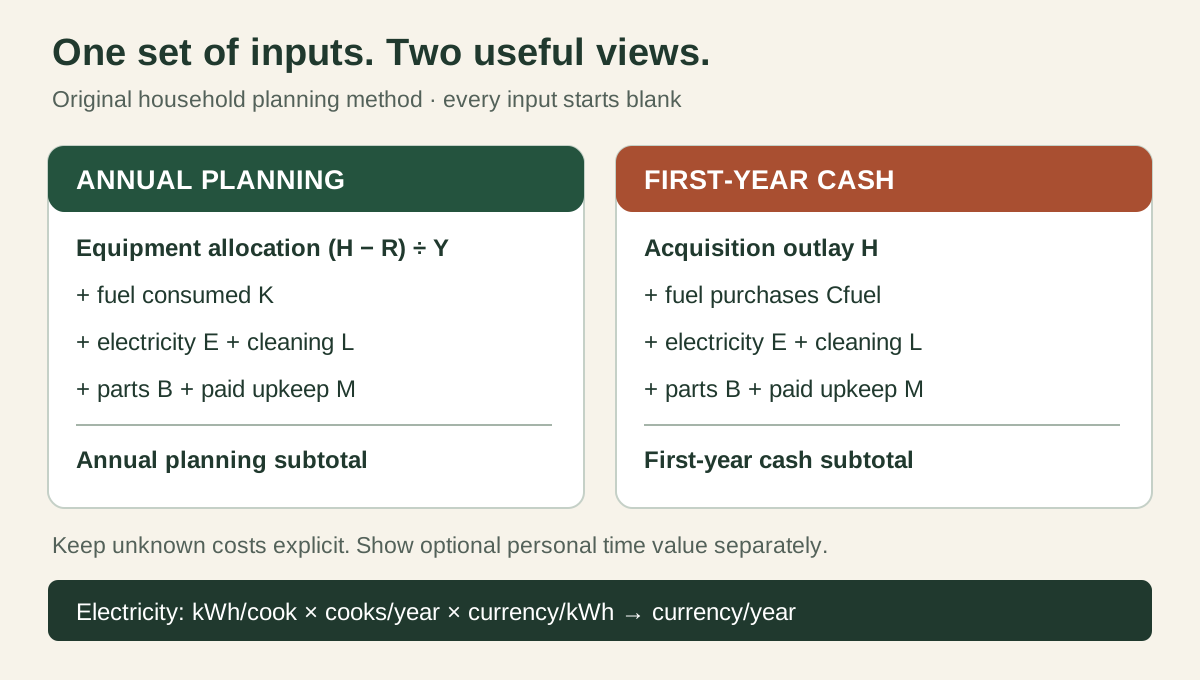
The formulas define this worksheet’s included categories. Add any relevant storage, financing or other expense explicitly, and do not label an incomplete subtotal “all-in ownership cost”; keep optional personal time value outside cash spending.
Three hypothetical cases: change one assumption at a time
Every value here is invented for arithmetic, with one unspecified smoker and one fictional cook definition. Assume equipment of 600 currency units, a five-year ownership period, zero resale, fuel at 1 per pound, cycle energy of 0.50 kWh at 0.20 per kWh, annual cleaning of 40 and annual parts of 25.
These examples omit actual tax, delivery, setup extras, storage, financing, service labor/freight and personal time. The equipment allocation is purchase-only: (600 − 0) ÷ 5 = 120 per year; no price quote, electricity measurement or failure prediction is implied.
On a narrow screen, scroll the table sideways to compare all columns.
| Case | Cooks/year | Assumed lb/cook | Fuel/year | Electricity/year | Running/year | Planning/year | Planning/cook |
|---|---|---|---|---|---|---|---|
| H01: lower frequency | 12 | 6 | 72.00 | 1.20 | 138.20 | 258.20 | 21.52 |
| H02: higher frequency | 36 | 6 | 216.00 | 3.60 | 284.60 | 404.60 | 11.24 |
| H03: higher assumed fuel | 36 | 9 | 324.00 | 3.60 | 392.60 | 512.60 | 14.24 |
For H01, fuel is 12 × 6 × 1 = 72 and electricity is 12 × 0.50 × 0.20 = 1.20. Add 40 for cleaning and 25 for parts to get running of 138.20; add equipment allocation of 120 to get planning of 258.20, or 21.52 per cook after rounding.
H02 spreads the same assumed annual equipment allocation over more cooks, lowering the per-cook figure while raising the annual modeled subtotal. H03 changes only assumed fuel use from H02, adding 108 per year and 3 per cook; neither comparison ranks smoker types or proves a household saving.
For a separate hypothetical cash view of H01, imagine 20-pound bags at 20 each, zero starting stock and four bags purchased. Cash fuel spending is 80, while consuming 72 pounds leaves eight pounds in stock and gives consumed value of 72.
The first-year cash subtotal is 600 + 80 + 1.20 + 40 + 25 = 746.20, with the same exclusions. Do not add the consumed value of 72 or the annual allocation of 120 again; they belong to the other view.
Use the result to ask a better buying question
Before comparing equipment, check whether a difference comes from purchase price, annual use, fuel assumptions or omitted charges. Replace the assumption most likely to change your decision with your own evidence, then recalculate; keep the original scenario so the reason for the change stays clear.
Use the pellet-smoker guide or kamado guide to research equipment that suits your cooking. Bring the completed worksheet to that comparison: it makes your budget’s boundaries visible without pretending all smokers share a standard cook.
Sources and method
- Traeger Pellets — public article JSONSource checked · support.traeger.com
- Weber EMEA: charcoal quantity recommendations — public article JSONSource checked · contact-emea.weber.com
- Weber New Zealand: Barbecue Briquette QuantitiesSource checked · anz.weber.com
- Traeger Service & Warranty: non-connected grills manufactured after October 2021Source checked · www.traeger.com
- US EIA: Measuring electricitySource checked · www.eia.gov
How this article is prepared
Researched and drafted with AI assistance from the cited sources. Examples and calculations retain their stated assumptions; illustrations do not establish restaurant visits or equipment tests.
About BBQ Explorer