Gear & care
Do pellet grills need electricity? Read the requirements for your model
On this page · 6 sections
Straight answer
Yes. The Traeger pellet families and Weber Searwood models examined here need electricity as well as pellet fuel. [1] [6] [7]
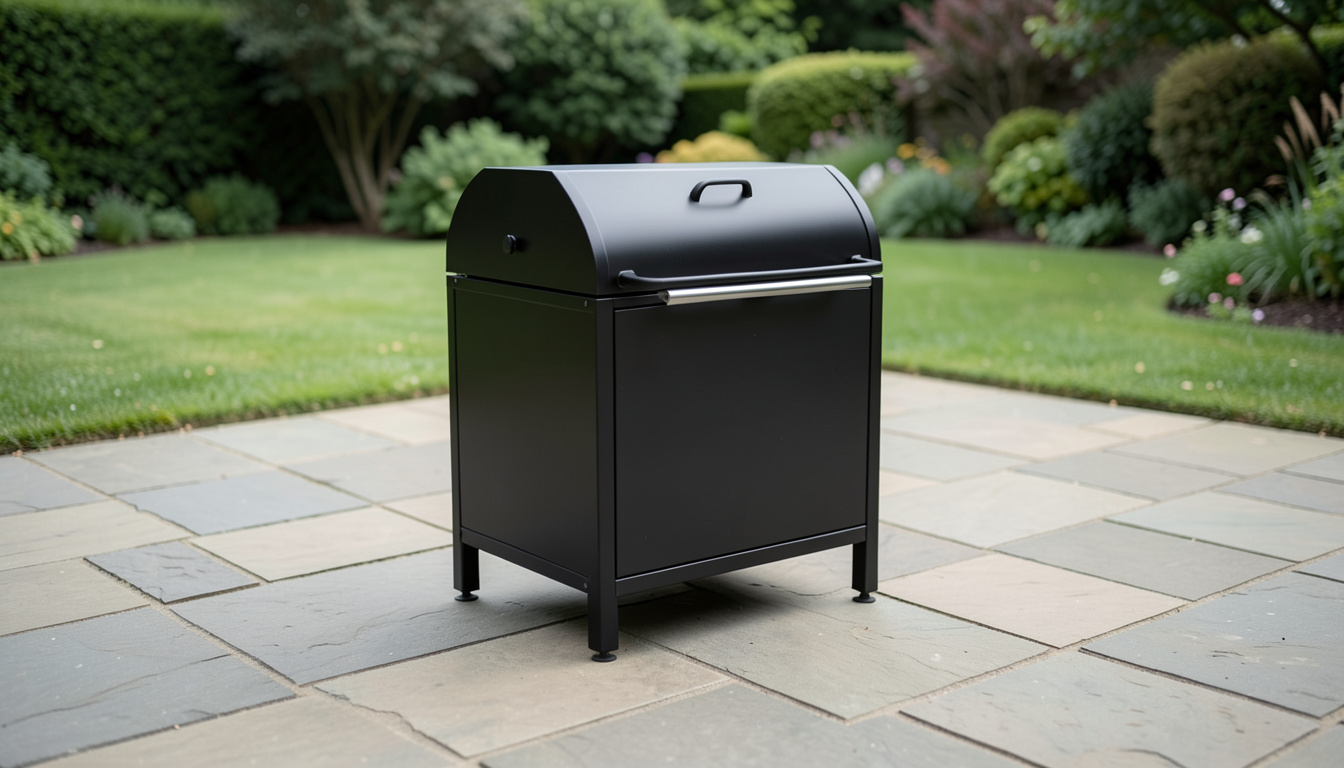
Start with the unit you own
Before choosing where a grill will sit, find its model number, market and matching owner’s manual. Keep the manual’s document number or revision beside your notes so a future search result does not silently replace the instructions you checked.
Traeger identifies the controller, fan and auger as electrically powered components. Its support chart describes greater power use during startup/heating, then reduced use after reaching temperature. [1]
The US Searwood manual specifies 120 V AC, 60 Hz and 1.3 A; the AU/NZ guide specifies 220–240 V AC, 50/60 Hz and 0.6 A. These describe separate market versions, not one unit’s selectable supply range. [6] [7]
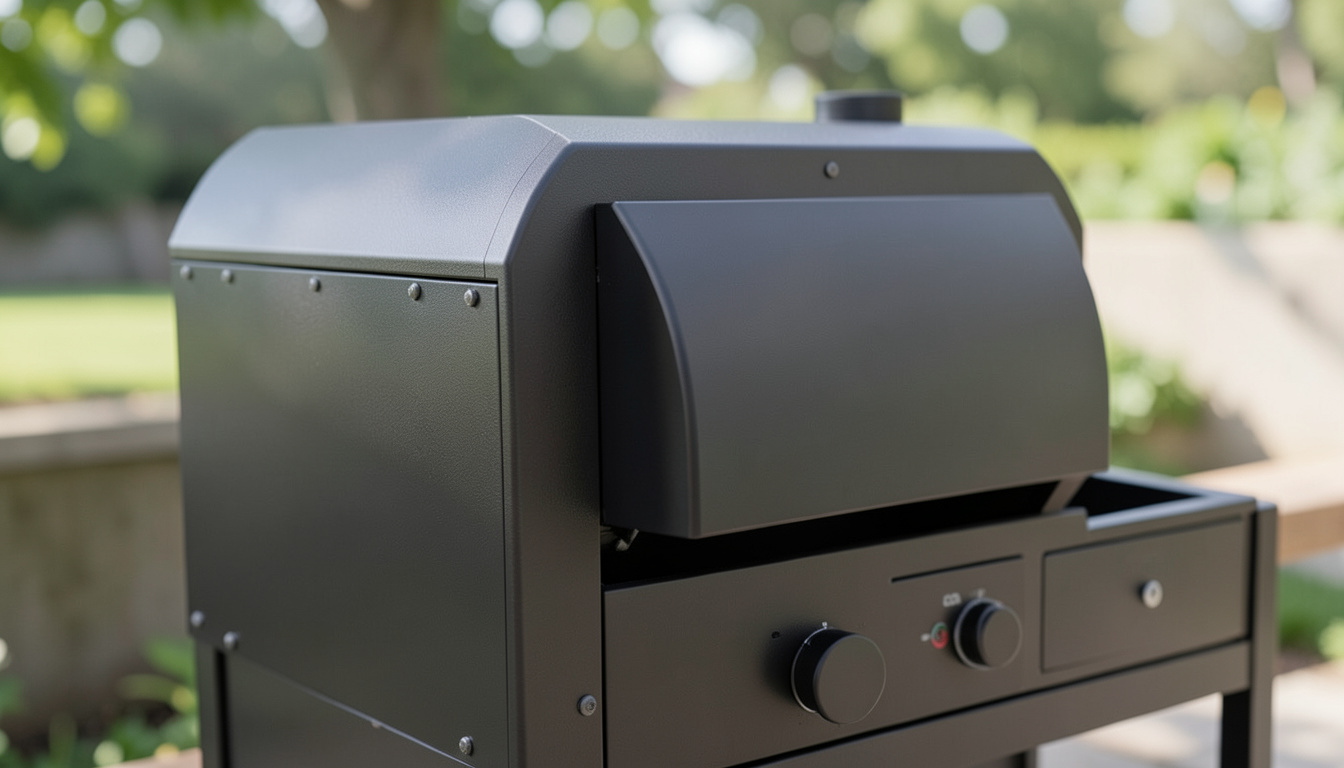
Use two separate questions in your notes: “What electrical supply and connection does the manufacturer require?” and “How much energy did my cook use?” The first is a setup question; the second needs an interval and an energy value, not merely a number copied from a rating table. [8]
Read the fields without filling in missing numbers
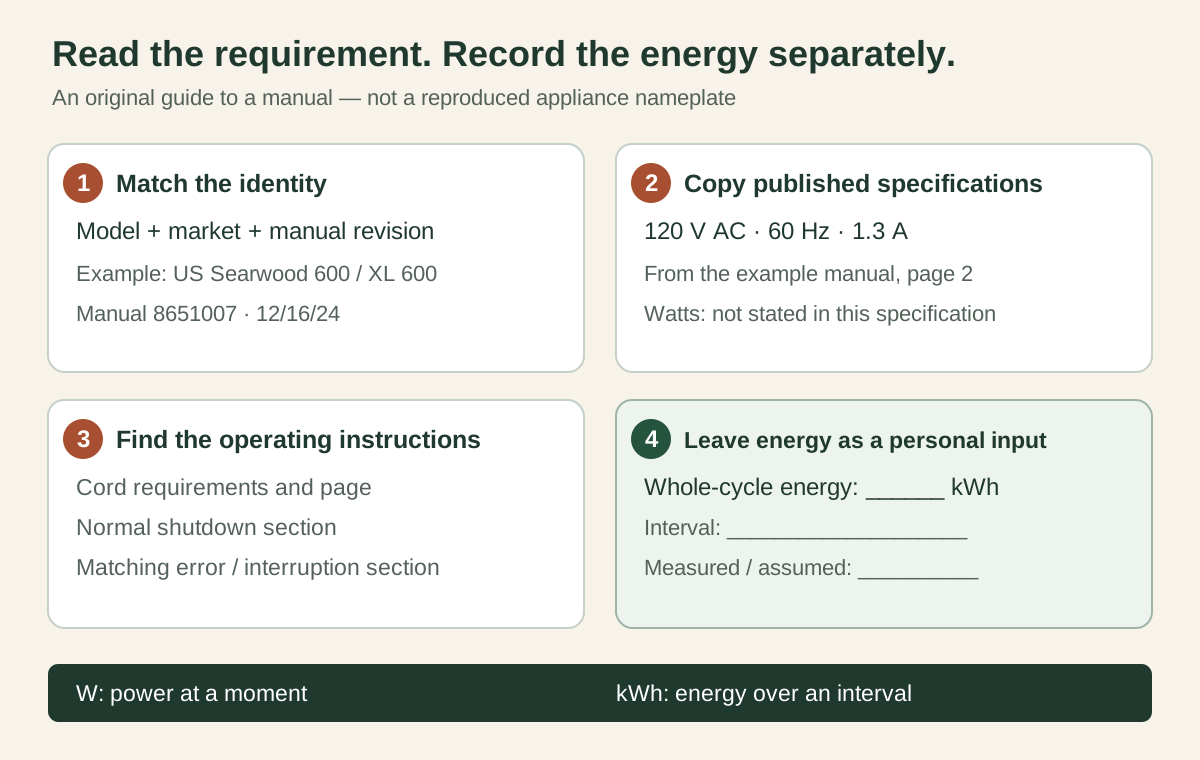
- Identity: copy the exact model and the market from the unit, then record the matching manual revision. Treat a family support page as broader guidance whose scope still needs checking.
- Supply: copy voltage and frequency exactly as published, keeping each model and market in its own row.
- Rating: retain the manufacturer’s label for watts or current. Write “not stated” when a source does not separate startup watts, running watts or cycle energy; do not rename a family rating “startup draw.”
- Connection and operation: find the cord section, normal shutdown section and the separately applicable error section. Save page numbers so the relevant instruction is available before an interruption.
Watts describe power at a moment; kilowatt-hours describe energy accumulated over time. For a genuinely known average load, kWh = average watts × hours ÷ 1,000; a single instantaneous or rated value does not establish that average. [8]
For your own energy record, define the whole interval: startup, cooking and the required normal shutdown. Keep any additional plugged-in standby period separate so two records cover the same thing; the Woodridge shutdown itself includes a running fan. [5]
Six examples, with the source boundaries left visible
This is a guide to reading published documents, checked October 18, 2026. The family rows are useful search starting points; the model rows show why an exact appliance label and matching manual still matter. No grill or power instrument was tested for this article.
On a narrow screen, scroll the table sideways to compare all columns.
| Model and scope | Published supply or power | Startup / running disclosure | Cord guidance and manufacturer interruption procedure |
|---|---|---|---|
| Traeger Non-WiFIRE, 120 V family [1] | 300 W; 2.5 A [1] | After heating: 0.4–0.8 A; startup watts not separated. [1] | Generic fixed 8-foot cord. Family power chart is not a recovery procedure; check the unit manual. [3] [1] |
| Traeger D2, 120 V family [1] | 110 W; 0.9 A [1] | After heating: 0.08–0.17 A; startup watts not separated. [1] | Generic detachable 8-foot D2-style cord. Mid-cook guide: confirm power-loss cause, then follow D2 checks; escalate as directed. [3] [9] |
| Traeger Pro 575, US product page and Pro Series manual [2] [4] | 120 V AC; 95 W on the product page [2] | Product page does not separate startup/running watts. [2] | Product: 6-foot D2 cord. Manual p4: No. 14 AWG grounded outdoor extension. D2 mid-cook troubleshooting is separate from p19 shutdown and p5 flame-out warning. [2] [4] [9] |
| Traeger Woodridge, 120 V family chart; T14815 manual [1] [5] | Grill only: 535 W; 4.5 A. [1] | Startup/running watts not separated in chart. [1] | Manual p4: No. 18 AWG versus support minimum 14 AWG. Complete p22 shutdown; use Woodridge-specific mid-cook checks and support route after an interruption. [5] [3] [9] |
| Weber Searwood 600/XL 600, US manual 8651007, 12/16/24 [6] | 120 V AC; 60 Hz; 1.3 A; watts not listed. [6] | Electrical specifications do not give phase watts or cycle kWh. [6] | P2: grounded outdoor 14-gauge extension, maximum 13 feet/4 m. P15 E10: cooling, cleanup, reassembly and diagnostics prerequisites. [6] |
| Weber Searwood 600, AU/NZ shortened guide 9501085 [7] | 220–240 V AC; 50/60 Hz; 0.6 A; watts not listed. [7] | Electrical specifications do not give phase watts or cycle kWh. [7] | P2: grounded outdoor 14-gauge extension, maximum 4 m. Consult this market’s matching error instructions. [7] |
Do not average the Pro 575 page’s 95 W with the D2 family chart’s 110 W, or assume the generic eight-foot cord describes every Pro 575’s supplied cord. The Woodridge manual’s No. 18 AWG and power-cord support page’s minimum 14 AWG remain a discrepancy to resolve with Traeger for the exact unit. [2] [1] [3] [5]
Keep cord figures attached to their cited models and documents. This table cannot establish a particular extension cable, generator or installation as compatible with your setup; save the unit details and the conflicting passages when asking the manufacturer to clarify.
Normal shutdown and an interruption are different jobs
Traeger’s WiFIRE mid-cook shutdown guide explicitly includes outages and tripped outlets/breakers among possible causes. Its path first checks whether power was lost, then separates D2 and Woodridge power/connection checks, app or firmware checks and support escalation; follow the section for the exact family. This troubleshooting article does not promise automatic restart or replace the unit’s operating instructions. [9]
The Woodridge manual describes a fan-assisted normal shutdown lasting about 15–25 minutes depending on the previous set temperature, and says not to switch off or unplug before it finishes. The Pro Series manual gives approximately 15 minutes for its normal shutdown. These are manufacturer instructions, not timings measured here. [5] [4]
For US Searwood manual 8651007, page 15 specifically addresses E10, meaning the prior shutdown was incomplete. It requires the shutdown to finish and the grill to cool completely before unplugging, then cleanup with fully extinguished ash and debris, reassembly, and powered diagnostics; a persistent E10 calls for regional customer service. [6]
Match the complete manufacturer section to the observed condition. Traeger’s Pro manual separately addresses a fire that goes out during cooking, including thorough cooling and unburned-pellet cleanup, so a normal-shutdown paragraph is not a substitute for that warning. [4]
- Record the exact model, manual revision, displayed error and what happened before the interruption.
- Locate the matching condition in the manual instead of combining another model’s shutdown and restart passages.
- If the documents disagree or the condition is not covered, use the manufacturer’s support route with those details before improvising a restart.
Keep a small record you can actually use
Your model’s electrical reading record
Start blank. Copy published specifications without relabeling them as measurements; leave a missing field unknown. Use the manual and page references above as a reading pattern. [8]
These entries are personal notes. They are not sent to a restaurant or submitted to this site.
Keep watts and amps with their original labels.
Record a measured value or clearly mark an assumption; this is separate from supply ratings. [8]
Sources and method
- Traeger Grill Watt & Amp Usage — public article JSONSource checked · support.traeger.com
- Traeger Pro 575 US product pageSource checked · www.traeger.com
- Traeger Power Cords — public article JSONSource checked · support.traeger.com
- Traeger Pro Series owner’s manual DOC419V-ASource checked · traegergrills.a.bigcontent.io
- Traeger Woodridge owner’s manual T14815Source checked · traegergrills.a.bigcontent.io
- Weber US Searwood 600/XL 600 owner’s manual 8651007Source checked · digital-assets.weber.com
- Weber AU/NZ Searwood 600 shortened owner’s guide 9501085Source checked · content-images.weber.com
- US EIA: Measuring electricitySource checked · www.eia.gov
- Traeger WiFIRE Grill Shuts off Mid-Cook — public article JSONSource checked · support.traeger.com
How this article is prepared
Researched and drafted with AI assistance from the cited sources. Examples and calculations retain their stated assumptions; illustrations do not establish restaurant visits or equipment tests.
About BBQ Explorer