Gear & care
Pellet grill cleaning: a task schedule for grease, ash and storage
On this page · 6 sections
Straight answer
Build a task list from your exact manual: inspect grease collection before cooking, record periodic ash tasks separately, and treat cold-ash conditions as their own requirement. The Pro 575/780 and base Woodridge examples below collect grease differently and have distinct maintenance headings; one cleaning interval cannot describe every task. [2] [3]
Pick the manual before choosing an interval
The examples use US English Traeger Pro 575/780 manual DOC419V-A and base Woodridge manual T14815, linked in the manufacturer’s manuals index checked October 18, 2026. Base Woodridge is a specific example; its drawing is not a parts map for Woodridge Pro/Elite, older Pro 22/34 or every touchscreen model. [1]
Put each task in one of three places: before-cook inspection, periodic cleaning, or storage/return to use. The distinction saves you from reading an ash-cleaning heading as permission to leave grease buildup unchecked until the same hour count. [2] [3]
Two collection paths, with ash kept visible
On a narrow screen, scroll the table sideways to compare all columns.
| Family / material | Documented path or task | What the owner still records |
|---|---|---|
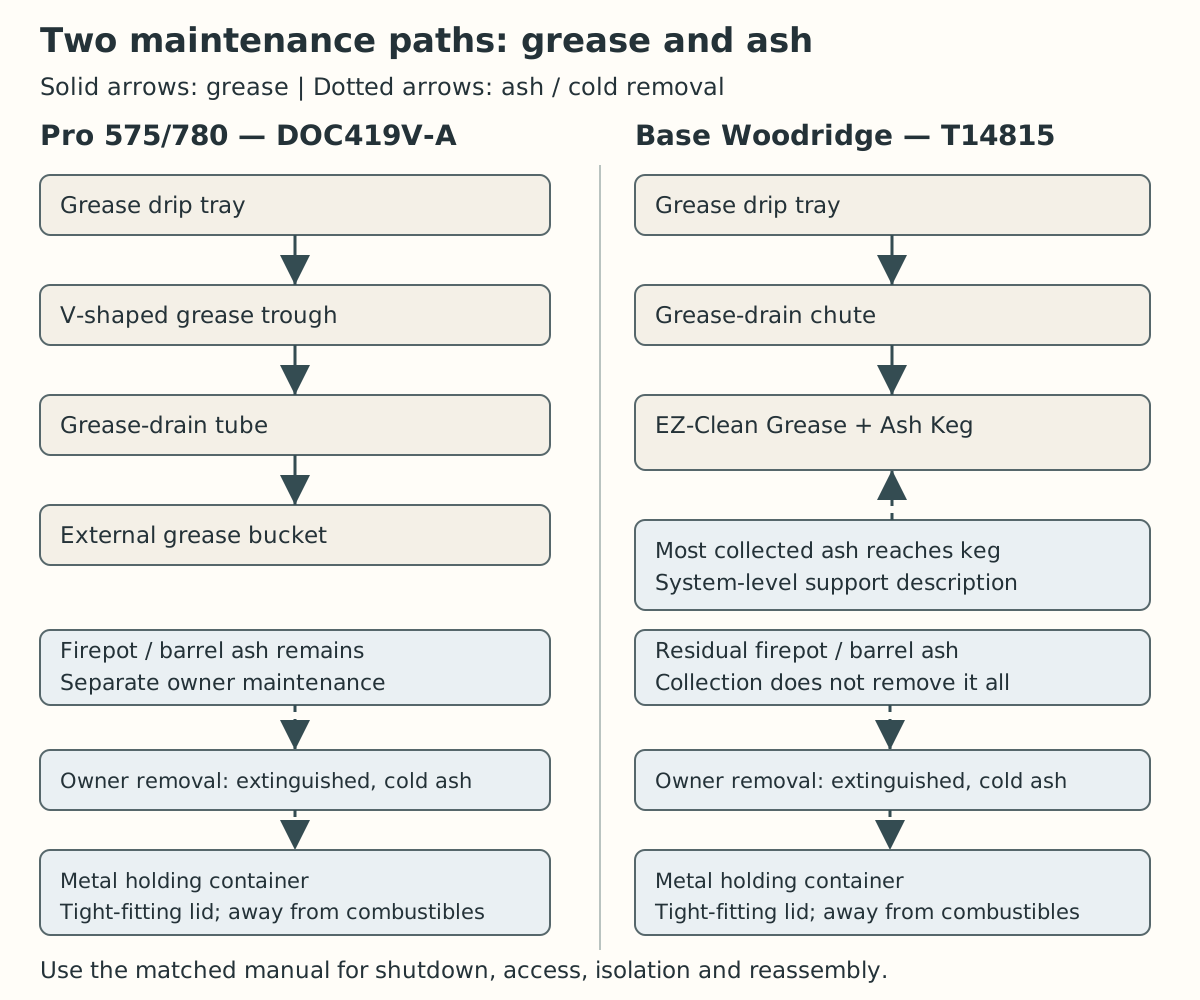
| Pro 575/780 grease | Grease drip tray → V-shaped trough → grease-drain tube → external grease bucket. [2] | Inspect all grease-system components before use; clean buildup, with fattier cooks potentially requiring more frequent cleaning. [2] |
| Pro 575/780 ash | Firepot/barrel ash has a separate cold-removal task; the external bucket is the grease route. [2] | Extinguished, cold ash and the actual ash task/condition, separate from bucket level. [2] |
| Base Woodridge grease | Drip tray → grease-drain chute → EZ-Clean Grease + Ash Keg. [3] | The manual calls for a before-every-cook keg check, emptying when full; grill and ash must be cold for that check. [3] |
| Woodridge-series collected/residual ash | Support describes most ash reaching the keg but also ash accumulating elsewhere; base-manual residual firepot/barrel cleaning remains. [3] [5] | Most is not all: record residual ash and the applicable cold-cleaning task rather than treating the keg as self-cleaning. [3] [5] |
| Cold-ash holding step | The named manuals specify a metal container with tight-fitting lid, on noncombustible floor/ground away from combustibles while awaiting final disposal. [3] [2] | Actual container/lid and completed cooling, not an assumed household-vacuum rating or local disposal permission. [3] |
Match each task to its trigger
On a narrow screen, scroll the table sideways to compare all columns.
| Trigger / scope | Pro 575/780 DOC419V-A | Base Woodridge T14815 / other source context |
|---|---|---|
| Before a cook | Inspect grease-management components for buildup; check the applicable ash task and condition. [2] | Check drip-tray buildup and keg; the keg check requires grill and ashes cold. [3] |
| Visible food, hardened grease or a fatty cook | Condition calls for cleaning; the manual says fattier food can require cleaning after each cook. [2] | The manual also uses buildup and fattier-food triggers. This does not wait for a monthly ash task. [3] |
| Named periodic ash heading | Page 26: every 20 hours of use; pre-cook checklist also says approximately 20 cooking hours. Keep ash-condition inspection active. [2] | Page 35: after approximately 20 hours of cooking. Page 34 separately has a monthly interior/firepot/chute section. Record both headings. [3] |
| Current general support recommendation | Cleaning support: deep clean after 2–3 cooks / 20–24 cooking hours, adjusted to cooking habits. This is not a new shelf-life rule. [4] | The ash support article for Woodridge-series/Timberline/Ironwood recommends vacuuming at least every 2 months, ideally after 24 cooking hours; retain its stated family scope and the matched manual’s task. [5] |
| Before storage / on return | Record completed cleaning, protection from moisture and a fresh pre-use inspection; fuel-storage decisions belong in the separate storage guide. [4] | Record keg/residual-ash condition and inspect again on return. The support’s after-storage section is a check prompt, not a universal sanitizing recipe. [4] |
Do not average those headings into a new interval. Write down which document and task you followed, the hours since that task and the buildup you observed; if instructions for your exact cooker remain unclear, resolve that model-specific question with the manufacturer before treating a generic support table as an override. [2] [3] [5] [4]
A finished shutdown is not proof the ash is cold
Copy the normal shutdown and maintenance power instructions from your own manual into the record before starting. Completion of a shutdown sequence and extinguished, cold ash are separate checks; the Pro ash heading and Woodridge keg/ash warnings expressly require the cold condition. [2] [3]
The current cleaning support permits certain grease wiping while warm, not hot, and both example manuals describe limited warm-grease work. That does not transfer to ash vacuuming or keg inspection, and it does not establish the permitted temperature for your grate tool. [4] [2] [3]
Traeger’s current cleaning support says not to use wire brushes on its grates. For any tool you plan to use, record its own model, material compatibility and temperature instructions, then check the current CPSC recall notices for an exact model match; this article recommends no particular tool or claims current recall clearance. [4]
Keep a printable check log for this cooker
Cooker and manual record
Fill these fields from the exact cooker and instructions. Leave observations blank until you inspect; do not populate a universal interval or invented cooking hours. [1] [4]
These entries are personal notes. They are not sent to a restaurant or submitted to this site.
Copy the exact model from the cooker identification.
Include replacement parts or changes that affect the instructions.
Record the actual source used.
Keep grease, ash and storage headings separate.
Your own record, not an estimate supplied by this article.
Use the tool and cooker instructions together.
A blank field is not a clearance result.
On a narrow screen, scroll the table sideways to compare all columns.
| Check | Date | Condition observed | Action | Next manual check |
|---|---|---|---|---|
| Drip tray / grease route | ________ | ________ | ________ | ________ |
| Bucket or cold keg level | ________ | ________ | ________ | ________ |
| Residual ash / task due | ________ | ________ | ________ | ________ |
| Required parts in place | ________ | ________ | ________ | ________ |
On a narrow screen, scroll the table sideways to compare all columns.
| Check | Date | Condition observed | Action | Next manual check |
|---|---|---|---|---|
| Matched shutdown and maintenance isolation | ________ | ________ | ________ | ________ |
| Grill and ash cold | ________ | ________ | ________ | ________ |
| Named grease path / residual ash cleaned | ________ | ________ | ________ | ________ |
| Cold-ash container and tight-fitting lid | ________ | ________ | ________ | ________ |
| Removed parts reinstalled / next task recorded | ________ | ________ | ________ | ________ |
On a narrow screen, scroll the table sideways to compare all columns.
| Check | Date | Condition observed | Action | Next manual check |
|---|---|---|---|---|
| Cleaning completed / condition dry | ________ | ________ | ________ | ________ |
| Cover / moisture observations | ________ | ________ | ________ | ________ |
| Return-to-use inspection | ________ | ________ | ________ | ________ |

Sources and method
- Traeger current manual index; separate model linksSource checked · www.traeger.com
- Traeger Pro575/780 US manual DOC419V-ASource checked · traegergrills.a.bigcontent.io
- Traeger base Woodridge US manual T14815Source checked · traegergrills.a.bigcontent.io
- Traeger current full cleaning article via public help-center JSONSource checked · support.traeger.com
- Traeger ash support for Woodridge-series,Timberline andIronwood via public JSONSource checked · support.traeger.com
How this article is prepared
Researched and drafted with AI assistance from the cited sources. Examples and calculations retain their stated assumptions; illustrations do not establish restaurant visits or equipment tests.
About BBQ Explorer