Gear & care
Offset smoker parts: read the heat path before naming the hardware
On this page · 6 sections
Straight answer
An offset smoker separates its fuel fire from the main food chamber. Identify the firebox, food grates, fuel support, heat-routing hardware and exhaust together: a conventional opposite-end stack and a sealed-pan reverse-flow return are different layouts. Parts also differ by model, so an ash drawer, grease drain and water pan should never be treated as interchangeable names. [1] [2] [4] [5] [6]
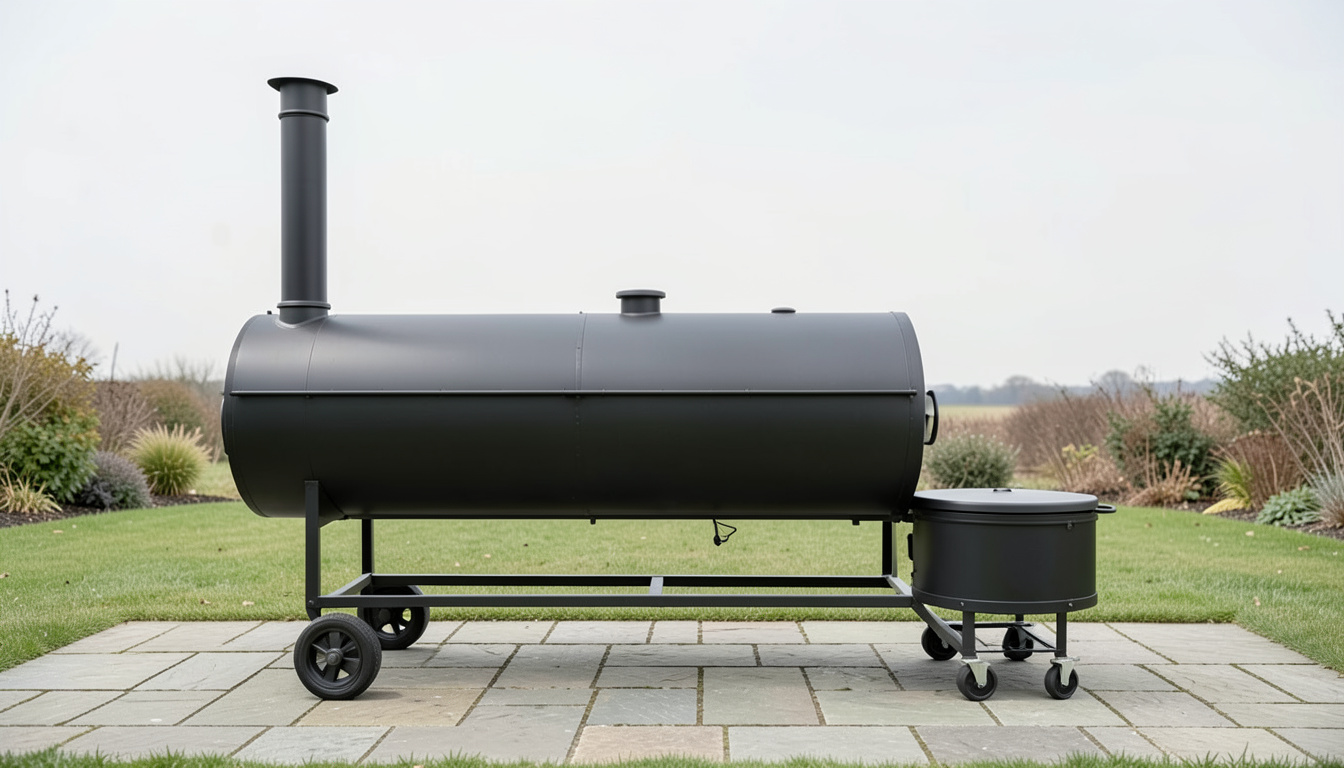
First separate food, fuel and the route between them
Open a parts diagram before adopting somebody else’s vocabulary. Yoder’s Loaded Wichita drawing separates the main cooking grates, a firebox cooking grate and a lower wood grate; the Highland 24203003 list separately names smoker cooking grates, firebox cooking grates, fire grates and a charcoal basket. The distinction matters when identifying a used cooker or ordering a replacement part. [2] [4]
A firebox food grate is a direct-grilling surface above the fuel support, rather than extra main-chamber smoking-rack capacity. Yoder illustrates that separate use, and the Highland manual supplies separate part numbers for those surfaces. Meadow Creek’s TS70P feature sheet lists a firebox charcoal grate and an optional charcoal grill pan; it does not make that optional accessory a standard firebox food grate. [2] [4] [8]
On a narrow screen, scroll the table sideways to compare all columns.
| Part | What to identify | What it must not be confused with |
|---|---|---|
| Firebox and access lid or door | The separate compartment containing the fuel fire. | The main chamber holding the smoking food. |
| Main cooking grates | Food-support surfaces in the smoking chamber. | A fuel grate, charcoal basket or heat-routing plate. |
| Firebox fuel grate or basket | Support or containment for the wood/charcoal fire. | The separate firebox food grate where one is supplied. |
| Plate, pan or baffles | The exact hardware beneath the food that shapes the documented route. | A universal sealed, welded or removable part. |
| Intake control and stack damper | Different air-path controls named in the model diagram. | A shared numerical setting suitable for every offset. |
| Ash drawer, grease drain and water pan | Different residue or liquid-handling parts; look up each separately. | One interchangeable cleanup compartment. |
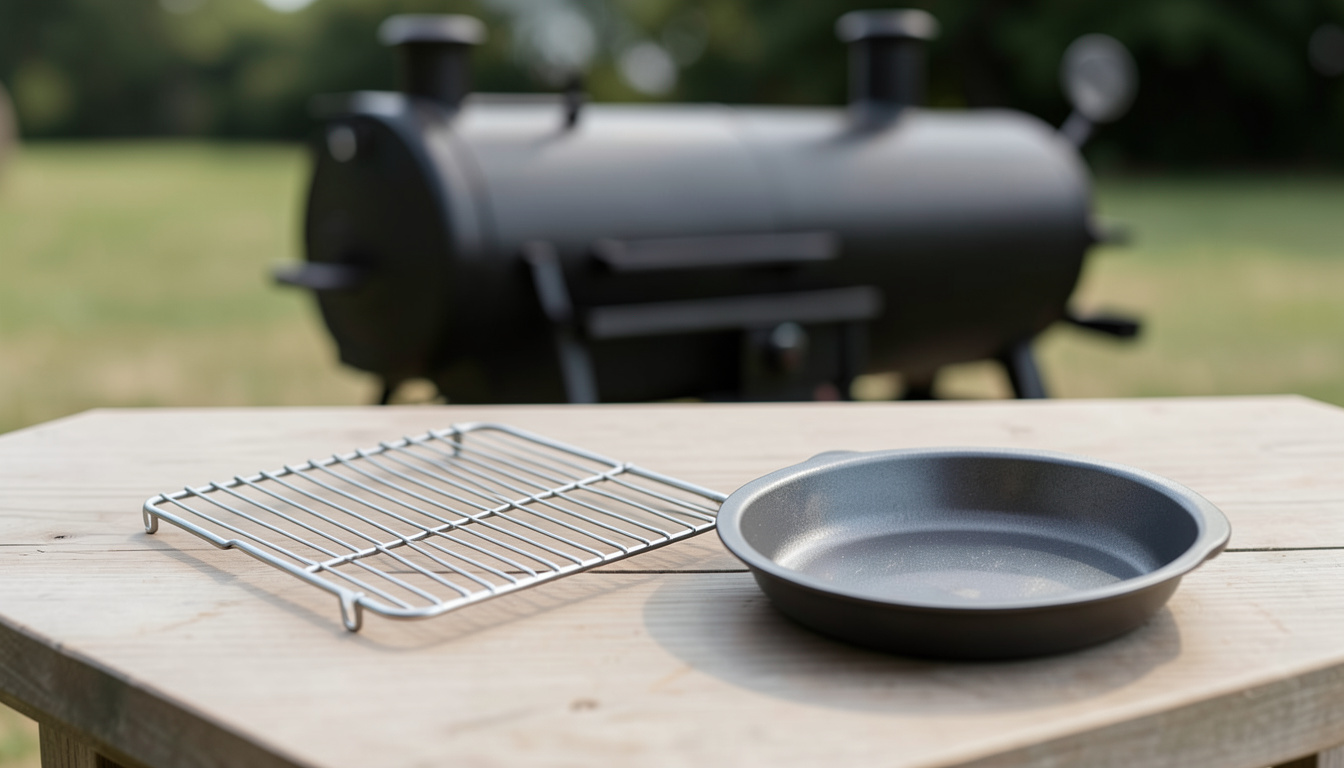
Conventional offset: exhaust at the far end
In the conventional layout used here, the stack sits at the chamber end opposite the firebox. The Yoder example also has a heat-management plate: its manual describes heat and smoke entering underneath it and being released progressively across the chamber. That plate does not turn this example into the sealed-pan return route shown next. [2] [5]
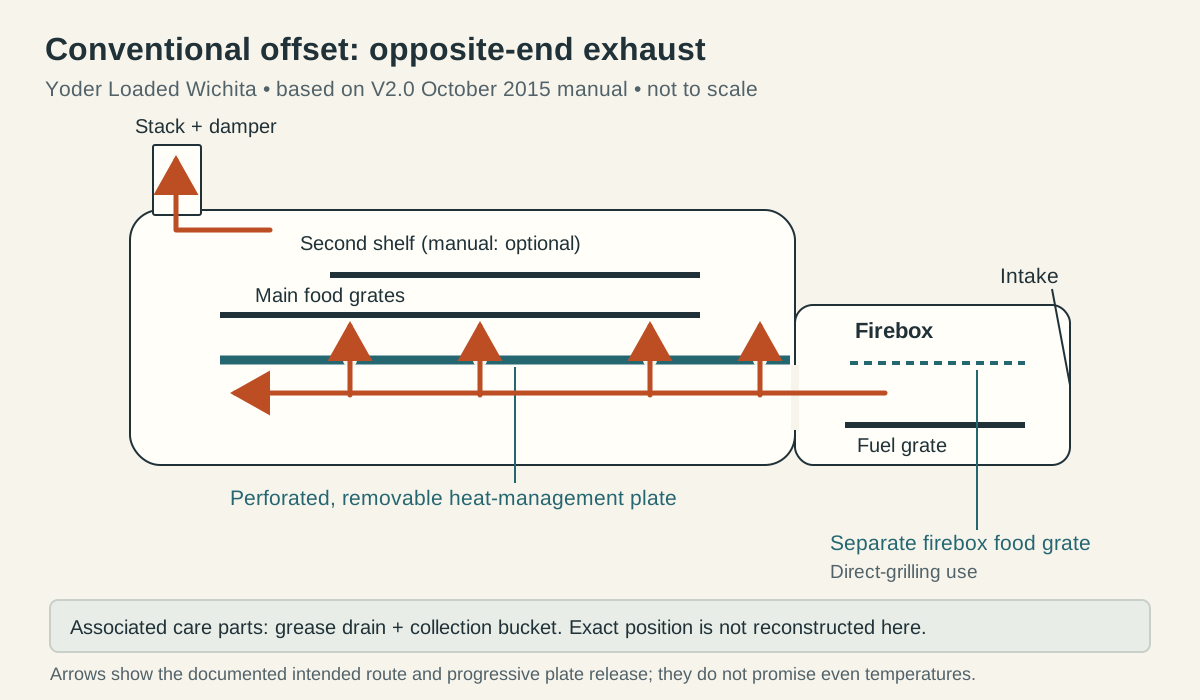
The drawing’s geometry is a simplified interpretation of the October 2015 manual, not a blueprint of every currently sold Wichita. The current Loaded Wichita product page confirms a removable heat-management plate and grease drain, while the older family manual labels some equipment as optional across its wider range. Match a replacement part to the actual unit rather than resolving that difference by appearance alone. [1] [2]
The intake and chimney controls are identified separately in Yoder’s direct-grilling diagram. Here they are vocabulary labels: their presence does not justify copying a damper position, drilling an opening or moving a chimney. Use the actual model’s operating instructions for those decisions. [2]
Sealed-pan reverse flow: out underneath, back over the food
Meadow Creek’s TS-family explanation sends hot gases from the side firebox beneath a sealed drip pan to the far end, then back through the food chamber toward the stack at the firebox end. The important distinction is the return above the pan. It describes the manufacturer’s intended path, not a measurement of every gas parcel or a promise of identical temperatures across the racks. [5]
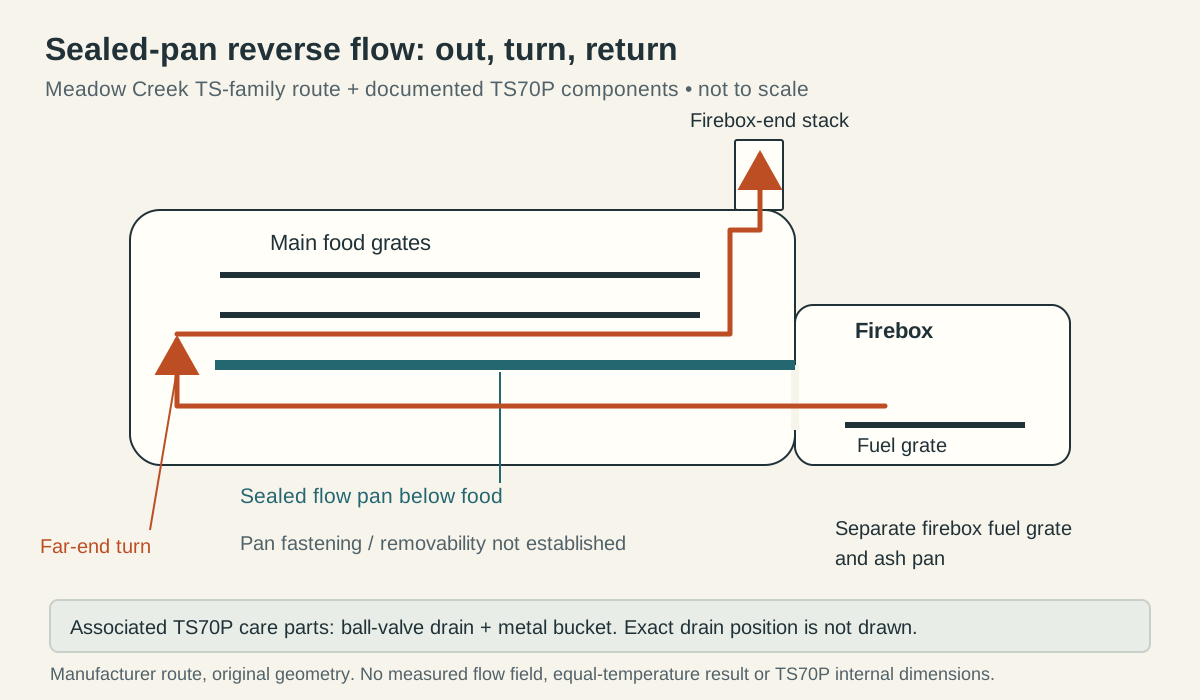
The TS70P specification calls its pan built in, and the family explanation calls the flow pan sealed. Those descriptions alone do not tell an owner whether the actual pan can be removed or how it is fastened. Treat a manual that does not answer a construction question as an unresolved question, not permission to lift, cut or alter the part. [5] [8]
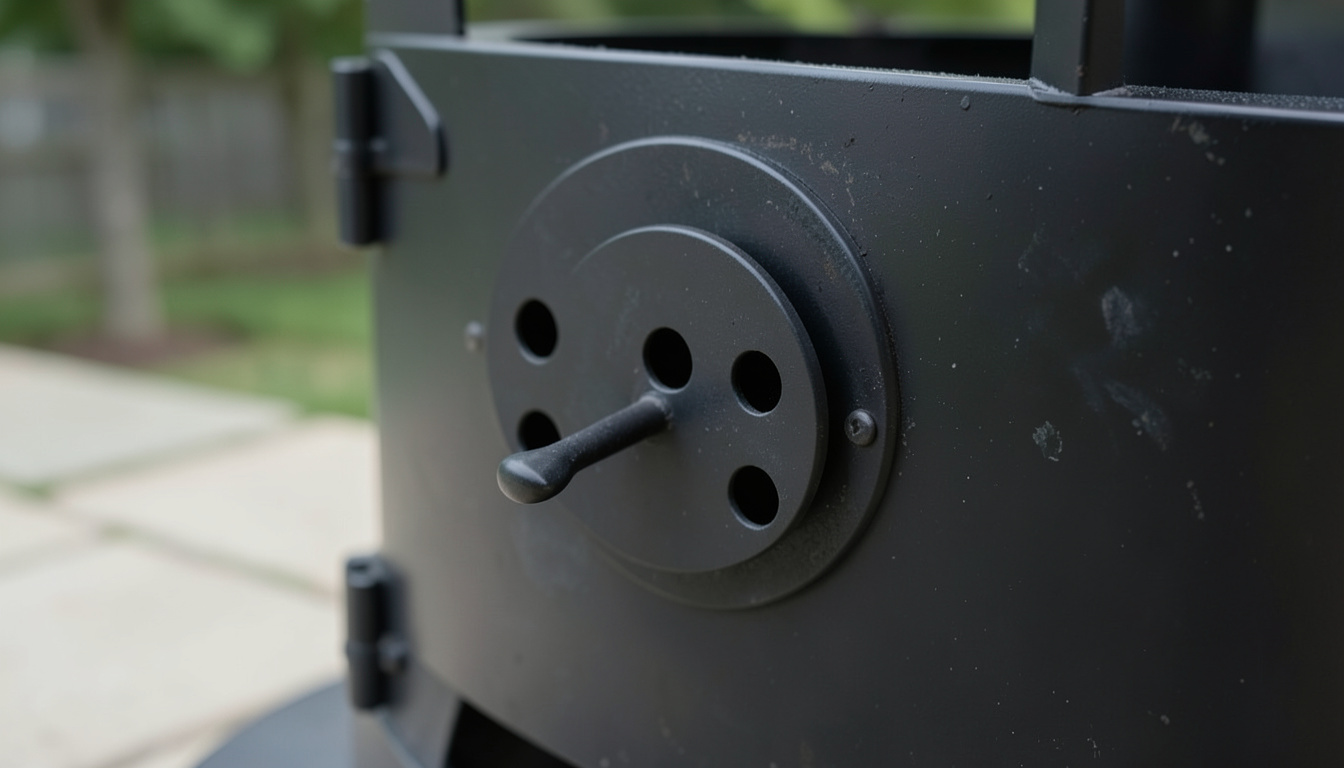
Reverse flow does not mean every cooker has the same plate
Oklahoma Joe’s Highland Reverse Flow model 24203003 lists four removable baffles and alternative stack positions. Its exact manual, PN 42805716 dated October 26, 2023, shows four distinct panels plus the stack near the firebox and a plug at the unused far-end stack opening. Do not redraw that hardware as Meadow Creek’s single sealed-pan arrangement. [3] [4]
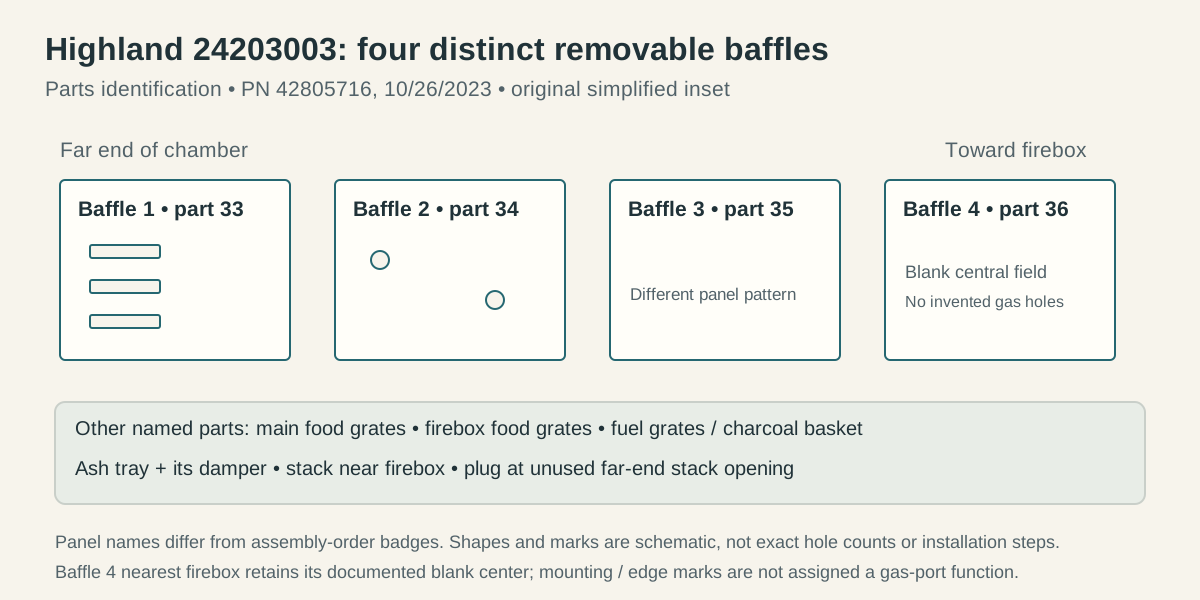
Panel names and assembly-order badges are different labels in that manual. Baffle 4, part 36, is shown nearest the firebox, while the panel called baffle 1 sits at the far end; their drawn openings are not uniform. This inset is for identifying the documented parts, not a new installation sequence or a measured Highland airflow map. [4]
The same parts list names an ash tray and an ash-tray damper. An ash tray is not established as a grease pan merely because it slides out; the manual reviewed here does not give a labeled grease-drain route. That gap does not prove the cooker has no drain, so consult the manufacturer for the exact unit before assigning a function to an opening. [4]
Map the cleanup route as carefully as the smoke route
Before buying a used offset, ask the seller to identify the cold-access parts against its manual. Find the grease collection route, the fuel-ash removal route and the food surfaces separately. The three examples below illustrate why one generic cleanup description can leave important hardware unnamed. [2] [4] [6] [7]
On a narrow screen, scroll the table sideways to compare all columns.
| Documented model | Plate or pan access | Grease route | Ash and food surfaces |
|---|---|---|---|
| Loaded Wichita, current product plus Yoder V2.0 manual | Removable heat-management plate; manual exposes the chamber floor for inspection. [1] [2] | Product names a grease drain; manual depicts a collection bucket and checks chamber buildup. [1] [2] | Yoder requires a completely cold grill for ash removal; cooking grates have separate care instructions. [2] |
| Highland Reverse Flow 24203003, PN 42805716 | Four removable baffles, with distinct parts and positions. [3] [4] | No labeled grease-drain procedure established in the manual reviewed; ask rather than assume. [4] | Slide-out ash tray is distinct from food grates and charcoal basket; follow the extinguished-and-cool care instructions. [4] |
| Meadow Creek TS70P and linked TS/SQ family guide | Built-in pan; these sources do not establish owner removability or fastening. [5] [8] | TS70P has a ball-valve drain; family guide specifies a metal bucket below the drain valve. [6] [7] | Two slide-out food grates and separate firebox fuel grate/ash pan; family guide calls for cleaned racks and thoroughly cooled coals. [6] [7] |

Record the parts on your actual smoker
Use the rating plate, exact manual and cold physical inspection. Leave unidentified parts blank and ask the manufacturer before disassembly or replacement.
These entries are personal notes. They are not sent to a restaurant or submitted to this site.
For purchase tradeoffs, continue to the offset buying guide. For a separate look at cooking-wood choices, use the wood-pairing reference. Knowing the parts gives those decisions a clear starting point without turning this explainer into a tuning or modification recipe.
Sources and method
- Yoder current Loaded Wichita productSource checked · www.yodersmokers.com
- Yoder General Backyard Smoker manual v2Source checked · www.yodersmokers.com
- Oklahoma Joe’s current Highland Reverse Flow 24203003Source checked · www.oklahomajoes.com
- Highland Reverse Flow exact owner/parts manualSource checked · images.salsify.com
- Meadow Creek Tank Smokers current catalogSource checked · www.meadowcreekbbq.com
- Meadow Creek TS70P current productSource checked · www.meadowcreekbbq.com
- Meadow Creek TS and SQ series owner manualSource checked · www.meadowcreekbbq.com
- Meadow Creek TS70P Dealer Guide specificationSource checked · www.meadowcreekbbq.com
How this article is prepared
Researched and drafted with AI assistance from the cited sources. Examples and calculations retain their stated assumptions; illustrations do not establish restaurant visits or equipment tests.
About BBQ Explorer