Meal planning
BBQ leftovers: a safe trip home, a useful label and a checked reheat
On this page · 6 sections
Straight answer
Keep the handling history with the food. USDA says to refrigerate leftovers promptly at 40°F or below, never leaving them out more than two hours, or one hour when the outside temperature is above 90°F; use refrigerated leftovers within three to four days or freeze them for longer storage. Reheat leftovers to at least 165°F throughout, but reheating does not replace the earlier discard decision. [1] [3] [4] [6]
The clock includes the meal and the ride
Start with the time the food spent outside verified temperature control, not the moment someone snapped a lid onto the box. USDA’s control conditions are cold food at or below 40°F and hot food at or above 140°F, checked with a thermometer. A closed container or an insulated bag by itself does not establish either food temperature. [6]
For perishable leftovers, USDA’s maximum outside time is two hours, shortened to one hour if the outside temperature is above 90°F. That means above 90°F, not 90°F or above; it also means more than the applicable hour limit, not an invented rule that exactly one or two hours automatically exceeds it. Refrigerate as soon as possible rather than planning to use the maximum as waiting time. [1] [6]
Consider a hypothetical box that spends 40 minutes on the table and 30 minutes on the ride, with no verified hot or cold control: 40 + 30 gives 70 minutes. Under ordinary conditions, 70 is below the two-hour ceiling, though the food still needs prompt cooling and an otherwise acceptable history; if all 70 minutes were spent with the outside temperature at 95°F, it would exceed the one-hour ceiling and should be discarded. These are invented planning inputs, not a measured meal or permission to ignore earlier unrecorded time. [1] [6]
If the history is unknown, do not turn the absence of a record into zero minutes. The conservative branch in the flow below is to discard when you cannot establish acceptable handling; USDA explicitly says to discard perishable food left out overnight beyond the limit even if it looks and smells good, and never taste it to check. This article cannot certify an unobserved box of food. [6]
A complete decision flow, including the return check
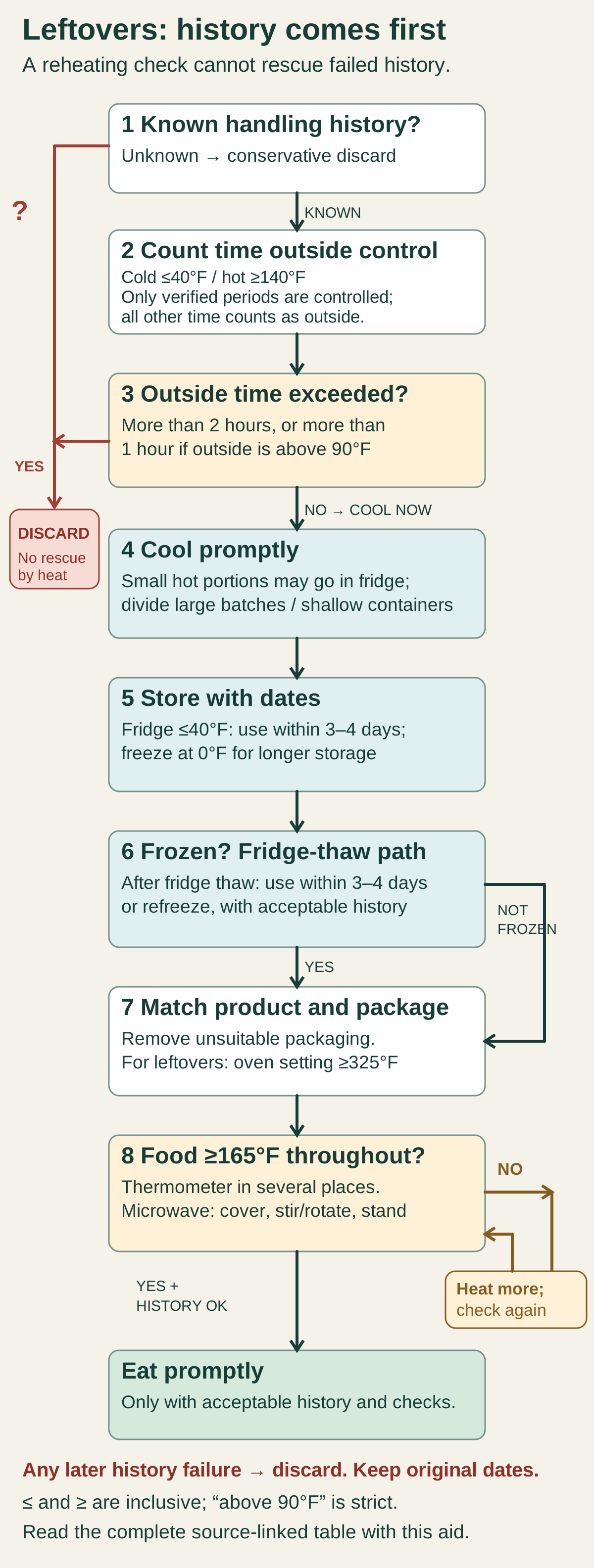
On a narrow screen, scroll the table sideways to compare all columns.
| Step / question | If yes / action | If no / limit |
|---|---|---|
| 1. Can you establish the food’s handling history? | Continue with the known time and verified control conditions. [6] | Unknown history: conservative choice is discard; do not guess from smell or taste. [6] |
| 2. Was it kept cold at or below 40°F, or hot at or above 140°F, verified by thermometer? | Treat only those verified periods as controlled. Assess all remaining time before continuing. [6] | Include meal, packing and travel time outside verified control; a new container does not prove a safe temperature. [1] [6] |
| 3. Did outside time exceed two hours, or one hour when the outside temperature was above 90°F? | Discard. Do not route failed history to reheating. [1] [6] | With acceptable history, promptly divide and refrigerate; the limits are not recommended waiting times. [1] [2] |
| 4. Are the portions small enough for prompt cooling? | Small amounts of hot food may go directly into the refrigerator. Cover the food. [2] | Divide a large pot into small portions and shallow containers; divide large meat cuts into smaller pieces. Do not wait on the counter for the whole batch to cool. [2] |
| 5. Will you use refrigerated leftovers within three to four days? | Keep refrigerator at 40°F or below; preserve dates and handling notes. [1] | Freeze promptly for longer storage at 0°F, with acceptable prior history. Freezing does not reverse a prior discard decision. [1] [6] |
| 6. Is a stored portion frozen? | This flow uses refrigerator thawing. USDA says use within three to four days after thawing or refreeze; apply that guidance to properly handled food, not to a failed history. [5] [6] | Continue to reheating only while the handling history and storage remain acceptable. [1] [6] |
| 7. Are the product, package and heating method matched? | Use suitable cookware and the exact compatible operator instructions below. An oven for leftovers must be set no lower than 325°F. [4] [7] [8] | Identify and remove unsuitable packaging before heating; do not assume that a supplied bag or foil container works in every appliance. [7] [8] |
| 8. Does the food reach at least 165°F throughout, checked in several places? | If history is still acceptable, eat promptly; keep the original handling record rather than issuing a new storage clock. [3] [4] [6] | Continue heating and return to this same temperature check. In a microwave, cover and rotate or stir, then allow standing time before checking several places. [3] [4] |
The flow deliberately has no arrow from a failed history to the oven. Reaching 165°F is the reheating requirement for otherwise properly handled leftovers, not a way around the earlier discard instructions. Cooling, freezing or reheating also does not justify erasing dates and treating the food as a newly purchased meal. [1] [3] [6]
Cool portions promptly and keep the storage history visible
You do not need to leave a small amount of hot food on the counter until it feels cool: USDA says it may go directly into the refrigerator. A large pot needs division into small portions and shallow containers; a large cut of meat needs smaller pieces. Cover the portions, and keep the refrigerator at 40°F or below. [2] [1]
USDA’s refrigerator window for leftovers is three to four days, or freeze for longer storage at 0°F. Write down the meal and chilling dates when you divide the food, and freeze a portion promptly if you do not expect to use it within that refrigerated window. Vacuum sealing, more sauce or a new lid supplies no extension in the guidance used here. [1]
For a frozen portion, this flow chooses refrigerator thawing. USDA says food thawed that way should be used within three to four days or can be refrozen; that is specific thawing guidance for properly handled food, not a claim that every thaw or reheat starts the same allowance. Its cold-water and microwave thawing paths have different conditions, so use the full USDA thawing instructions if choosing either of those methods. [5]
Two operator examples, with the package and method kept attached
On a narrow screen, scroll the table sideways to compare all columns.
| Operator / product scope | Packaging and selected method | What the instruction does not establish |
|---|---|---|
| Jack Stack restaurant carryout guide. [7] | Remove products from plastic containers before oven or grill heating, and from foil containers before microwave heating. Use the appropriate item row in the carryout guide. [7] | These package-removal rules do not provide the food’s handling history or prove a measured 165°F endpoint; use USDA’s checks too. [3] [4] |
| Dreamland packaged chopped pork or chicken; its named oven section. This is a packaged-product example, not a statement about every restaurant’s carryout container. [8] | Its general instructions remove meat from plastic. The selected oven section specifies 350°F, loosening the meat into a baking pan on the middle rack, and a 20–30 minute heating estimate; its general meat endpoint is 165°F. [8] | The estimate is not a temperature measurement. Dreamland says not to defrost or reheat meat in a microwave and gives no reason; keep that vendor instruction with its product. [8] |
Open the Jack Stack carryout guide or Dreamland reheating guide and match the exact item and supplied label before starting. Jack Stack’s separate shipping instructions concern another channel; Dreamland’s directions for another meat form or appliance do not replace its chopped-meat oven section. If a label conflicts with the online method, resolve that exact product question before using it. [7] [8]
For leftovers, USDA calls for at least 165°F throughout, verified with a thermometer in several places; the oven setting and elapsed minutes are different measurements. Its oven minimum is 325°F, while sauces, soups and gravies should be brought to a boil. USDA does not recommend slow cookers or chafing dishes for reheating leftovers, so they are not an alternative branch in this flow. [3] [4]
For a product whose instructions permit a microwave, USDA calls for covering and rotating or stirring the food, followed by standing time before checking its temperature in several places. If any checked location has not reached 165°F, continue heating and check again; do not substitute the first hot edge for the whole portion. Dreamland’s no-microwave instruction still applies to its product example above. [3] [4] [8]
A container label that records decisions and a date
Blank BBQ-leftover container label
Fill this in for each portion from actual observations. Unknown is a reason to resolve the handling history, not a blank you can treat as zero; preserve the original dates through freezing, thawing and reheating.
These entries are personal notes. They are not sent to a restaurant or submitted to this site.
This handling aid was built from USDA’s current rendered AskUSDA answers and the two named operators’ full instructions, checked October 18, 2026. It does not measure your meal, certify a container for an appliance or supply a quality trick for dry meat. The flow makes its conservative unknown-history choice explicit rather than inventing a safe answer from missing time or temperature readings.
Sources and method
- USDA: How do I handle leftovers safely?Source checked · ask.fsis.usda.gov
- USDA: Can you put hot food in the refrigerator?Source checked · ask.fsis.usda.gov
- USDA: How do I reheat leftovers safely?Source checked · ask.fsis.usda.gov
- USDA: How do I reheat leftover take-out food?Source checked · ask.fsis.usda.gov
- USDA: How do you thaw leftovers safely?Source checked · ask.fsis.usda.gov
- USDA: Is food safe if left out overnight?Source checked · ask.fsis.usda.gov
- Jack Stack carryout heating instructionsSource checked · www.jackstackbbq.com
- Dreamland product reheating instructionsSource checked · shop.dreamlandbbq.com
How this article is prepared
Researched and drafted with AI assistance from the cited sources. Examples and calculations retain their stated assumptions; illustrations do not establish restaurant visits or equipment tests.
About BBQ Explorer