Meal planning
How much cooked BBQ per person? Plan by serving style
On this page · 7 sections
Straight answer
Use the supplier’s serving unit before multiplying a guest count. A pound advertised for mini sliders, a nominal buffet portion and a family pack’s listed pounds describe different orders; declare sandwich count, portion choice and rounding, then confirm bones, sides and increments. [1] [3] [2]
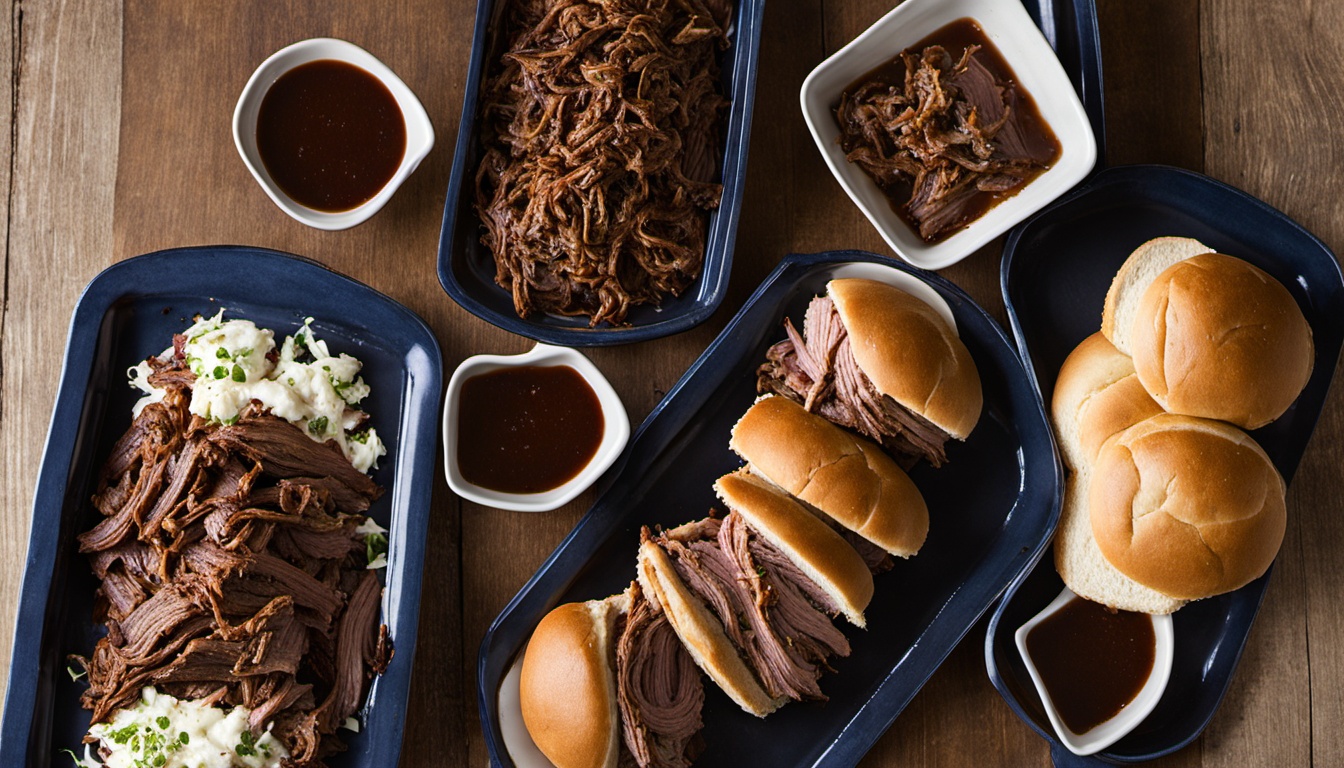
Choose the serving unit before multiplying
A guest count is not a food-weight basis. Write the number receiving this meal, the serving style and the supplier’s stated unit before calculating; people, mini sliders, listed pack pounds and rib slabs answer different questions.
Cooked boneless meat means meat after cooking without bones. USDA uses that distinction in an institutional Child Nutrition Programs buying guide; its crediting rules are not restaurant appetite advice. Its yield discussion also depends on cooking method, time and temperature, so it supplies no universal smoked-packer factor here. [4]
- Choose any separate child or alternate-meal portion explicitly; no automatic half-portion is built into this worksheet.
- Keep ribs, slabs and chicken pieces in their own count units until the supplier states a usable boneless basis.
- Keep side volume separate from meat weight: one quart of sides is not assumed to weigh one pound.
- Choose deliberate extras and the supplier’s permitted increments openly; the examples contain no default waste or safety percentage.
Four menu bases from three operators
Joe’s and Terry Black’s pages were rechecked October 7, 2026. Three Li’l Pigs uses the genuine October 3 selected-tab menu capture because the October 7 recheck returned a connection-security/cookie challenge; its dated menu is not a claim of current price or availability.
On a narrow screen, scroll the table sideways to compare all columns.
| Operator / channel | Published basis | Arithmetic for comparison only | Confirm with supplier |
|---|---|---|---|
| Joe’s KC, Kansas City area; party planner | 1 listed lb makes 6–8 mini sliders; planner scope up to 50. [1] | 16 ÷ 8 = 2 oz; 16 ÷ 6 = 2⅔ oz per mini slider. A per-person amount requires a chosen slider count. | Meal appetite, sides, actual availability and allowed weighed/bread increments. |
| Three Li’l Pigs, Daleville, VA; pickup pack | 1 lb BBQ advertised for 3–4 people, with sides and four buns. [3] | 16 ÷ 4 = 4 oz; 16 ÷ 3 = 5⅓ oz listed BBQ per advertised person. | Seconds, appetite, meat mix and whether the stated weight suits selected bone-in items. |
| Three Li’l Pigs; drop-off buffet | Regular ⅓ lb or larger ½ lb nominal portion, two sides; menu basis 40 or more, two BBQ choices. [3] | ⅓ × 16 = 5⅓ oz; ½ × 16 = 8 oz. These are different package choices, not a confidence interval. | Whether nominal meat is one pooled total; split, bones and side quantities. |
| Terry Black’s, Lockhart, TX; large family pack | 6 listed lb meat / 5 qt sides / advertised 10–12 people; beef ribs excluded. [2] | 6 ÷ 12 = ½ lb; 6 ÷ 10 = 0.6 lb listed meat. Sides: 5/12–½ qt per advertised person. | Permitted selections, remaining bones and edible boneless weight. |
Three hypothetical orders for 40 meal guests
All three cases assume 40 people receiving this BBQ meal. Two sliders each, selection of a menu portion and choosing the low end of a pack feed range are declared host choices; none is a tested appetite recommendation. The cases use different food and service assumptions and should not be ranked as correct or wasteful.
On a narrow screen, scroll the table sideways to compare all columns.
| Case / chosen assumptions | Formula and result | Provisional order and unknowns |
|---|---|---|
| A — two Joe’s-style mini sliders each; no extra food | 40 × 2 = 80 sliders. At 8/lb: 80 ÷ 8 = 10 lb. At 6/lb: 80 ÷ 6 = 13⅓ lb. [1] | 10–13⅓ listed lb is yield arithmetic. 80 buns is the desired count, not a vendor order increment; order bread separately and confirm sides/increments. |
| B — two-meat Three Li’l Pigs-style buffet with two sides | Regular: 40 × ⅓ = 13⅓ nominal lb. OR larger: 40 × ½ = 20 nominal lb. Difference: 6⅔ lb, or 50% of regular. [3] | Choose one alternative. Assume one pooled nominal total across both meats solely for this example; confirm combined basis, split, bones and sides. Do not apply the full portion twice. |
| C — whole Terry Black’s large family packs; use 10 advertised people per pack | ceil(40 ÷ 10) = 4 packs. 4 × 6 = 24 listed lb; 4 × 5 = 20 qt sides. Advertised range: 40–48 people. [2] | Whole-pack rounding; 24 ÷ 40 = 0.6 listed lb per actual meal guest. No boneless-yield or adequacy guarantee; confirm allowed meat mix and bones. Beef ribs excluded. |
On a narrow screen, scroll the table sideways to compare all columns.
| Declared choice | Arithmetic | Limit |
|---|---|---|
| Six guests receiving the supplier’s rib meal | Joe’s advertised 2–3 people per slab: ceil(6 ÷ 3) = 2 slabs; ceil(6 ÷ 2) = 3 slabs. [1] | The source lists 11–12 bones/slab, not edible meat weight; this does not make all ribs interchangeable. |
Write your own order basis
Blank cooked-BBQ order worksheet
Start every field with your own supplier or host input. For per-person cooked portions, sum each distinct meal group’s count × its explicitly chosen portion; for sandwich yield, divide desired sandwiches by sandwiches per pound; for whole packs, round up meal count ÷ chosen advertised pack service count. Keep bone-in units separate and confirm permitted increments.
These entries are personal notes. They are not sent to a restaurant or submitted to this site.
Supplier, location and dated menu URL; record the exact menu and date.
Service style: sliders, sandwiches, plated meal, buffet or packaged meal.
Total people receiving this BBQ meal; exclude guests assigned a separate meal.
Adult meal count; this label does not set their appetite.
Child meal count; do not automatically use half an adult portion.
Supplier or host’s explicitly chosen child portion / sandwich count; leave unresolved if unknown.
Sandwiches or sliders per meal guest, when relevant; host choice.
Published low serving count / portion basis; state people, sandwiches, pounds or package units.
Published high serving count / alternate package basis; do not call package choices a confidence interval.
Cooked boneless meat, listed pack meat including bones, or bone-in units; confirm the supplier’s basis.
Calculated lower cooked order / lb or package units; show the formula.
Calculated upper cooked order / lb or package units; show the formula.
Meat choices and shares; shares across a pooled meat total must add to 100%.
Ribs/slabs/chicken pieces and counts; record separately from boneless lb.
Side choices and supplier-confirmed container sizes / servings; never assume one quart weighs one pound.
Bun or bread count and included items; specify the desired sandwich count.
Deliberately chosen extra amount / lb, sandwiches or packs; blank instead of a default percentage.
Permitted weighed increments or whole-pack rounding; check with supplier.
Meal/order minimum and confirmation/order deadline from this supplier.
Supplier-confirmed order, holding/leftover arrangements and unresolved questions.
On a narrow screen, scroll the table sideways to compare all columns.
| Worksheet field | Separate filled example |
|---|---|
| Supplier and source | Three Li’l Pigs, Daleville; catering menu captured October 3, 2026 UTC; current availability unverified. |
| Serving style | Drop-off buffet with two meat choices and two sides. |
| People receiving the BBQ meal | 40 sample meals. |
| Adult meal count | 40 using the same chosen portion; no appetite inference. |
| Child meal count | 0 separately portioned children in this illustrative order. |
| Explicit child portion basis | No separate child basis used; choose one if needed. |
| Sandwiches or sliders each | Not a sandwich-count example. |
| Published lower serving basis | Regular nominal ⅓ lb BBQ per meal. |
| Published upper or alternate basis | Larger ½ lb is a separate choice, not an uncertainty bound. |
| Supplier weight basis | Nominal menu allocation; confirm combined/boneless basis and bones. |
| Calculated lower order | 40 × ⅓ = 13⅓ nominal lb. |
| Calculated upper order | 13⅓ nominal lb for the chosen regular option; alternative 20 lb not added. |
| Meat choices and split | Two choices; identities and pooled shares require supplier confirmation. |
| Bone-in items and counts | No bone-in count selected; ask before substitutions. |
| Side choices and containers | Two side choices; volumes and servings to confirm. |
| Bread or bun count | Bun inclusion/count to confirm for this order. |
| Deliberately chosen extra food | 0 lb deliberately added for arithmetic only; not a recommended buffer. |
| Order increments and rounding | Permitted weight increments to confirm; no default rounding used. |
| Minimum and order deadline | Menu basis 40 met; actual deadline and written confirmation to obtain. |
| Final confirmation and questions | Confirm meat split/basis, sides, buns, increments, event availability and holding/leftover arrangements. |
Overview and every readable diagram label
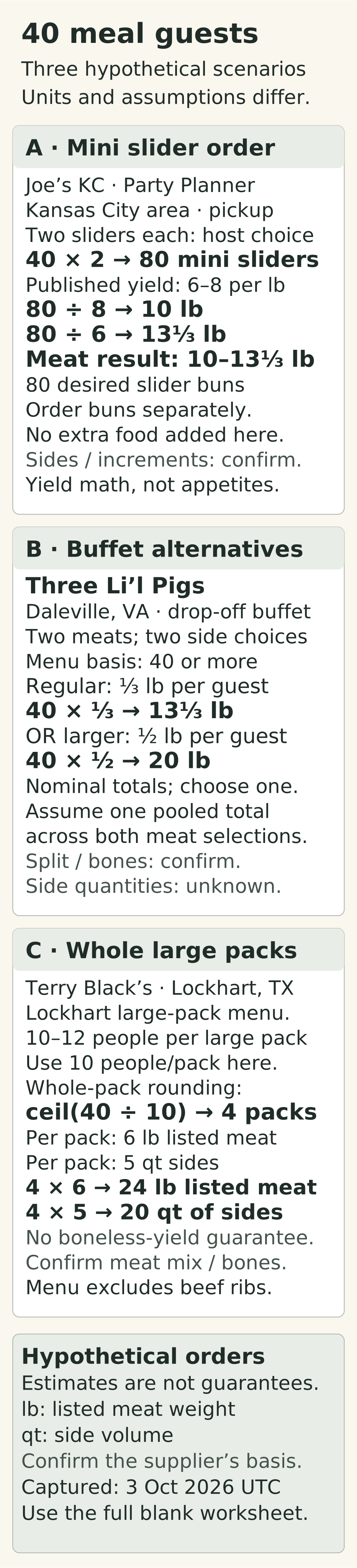
On a narrow screen, scroll the table sideways to compare all columns.
| Diagram panel | All original visible label text |
|---|---|
| Overview | 40 meal guests · Three hypothetical scenarios · Units and assumptions differ. |
| A — chosen mini-slider count | A · Mini slider order · Joe’s KC · Party Planner · Kansas City area · pickup · Two sliders each: host choice · 40 × 2 → 80 mini sliders · Published yield: 6–8 per lb · 80 ÷ 8 → 10 lb · 80 ÷ 6 → 13⅓ lb · Meat result: 10–13⅓ lb · 80 desired slider buns · Order buns separately. · No extra food added here. · Sides / increments: confirm. · Yield math, not appetites. |
| B — buffet alternatives | B · Buffet alternatives · Three Li’l Pigs · Daleville, VA · drop-off buffet · Two meats; two side choices · Menu basis: 40 or more · Regular: ⅓ lb per guest · 40 × ⅓ → 13⅓ lb · OR larger: ½ lb per guest · 40 × ½ → 20 lb · Nominal totals; choose one. · Assume one pooled total · across both meat selections. · Split / bones: confirm. · Side quantities: unknown. |
| C — whole large packs | C · Whole large packs · Terry Black’s · Lockhart, TX · Lockhart large-pack menu. · 10–12 people per large pack · Use 10 people/pack here. · Whole-pack rounding: · ceil(40 ÷ 10) → 4 packs · Per pack: 6 lb listed meat · Per pack: 5 qt sides · 4 × 6 → 24 lb listed meat · 4 × 5 → 20 qt of sides · No boneless-yield guarantee. · Confirm meat mix / bones. |
| Units and limits | Menu excludes beef ribs. · Hypothetical orders · Estimates are not guarantees. · lb: listed meat weight · qt: side volume · Confirm the supplier’s basis. · Captured: 3 Oct 2026 UTC · Use the full blank worksheet. |
Confirm the order without borrowing raw-yield assumptions
Take the chosen calculation to the supplier with the actual event, meat choices, sides and desired bread count. Resolve every unknown before treating the provisional result as the order; a menu serving estimate does not confirm an event or tell how much each guest will eat.
Preparing raw brisket is a separate task. The brisket cost calculator owns raw purchase/yield assumptions, including a braised-flat reference that is not smoked whole-packer yield; do not use it to convert this cooked restaurant order. The cost page explains broader pricing units, and city guides provide destination context.
Sources and method
- Joe’s KC — party plannerSource checked · www.joeskc.com
- Terry Black’s — Lockhart menuSource checked · terryblacksbbq.com
- Three Li’l Pigs — retained October 3 selected service-tab menuSource checked · threelilpigsbbq.com
- USDA Food Buying Guide — opened institutional meat definitions and yieldsSource checked · foodbuyingguide.fns.usda.gov
How this article is prepared
Researched and drafted with AI assistance from the cited sources. Examples and calculations retain their stated assumptions; illustrations do not establish restaurant visits or equipment tests.
About BBQ Explorer